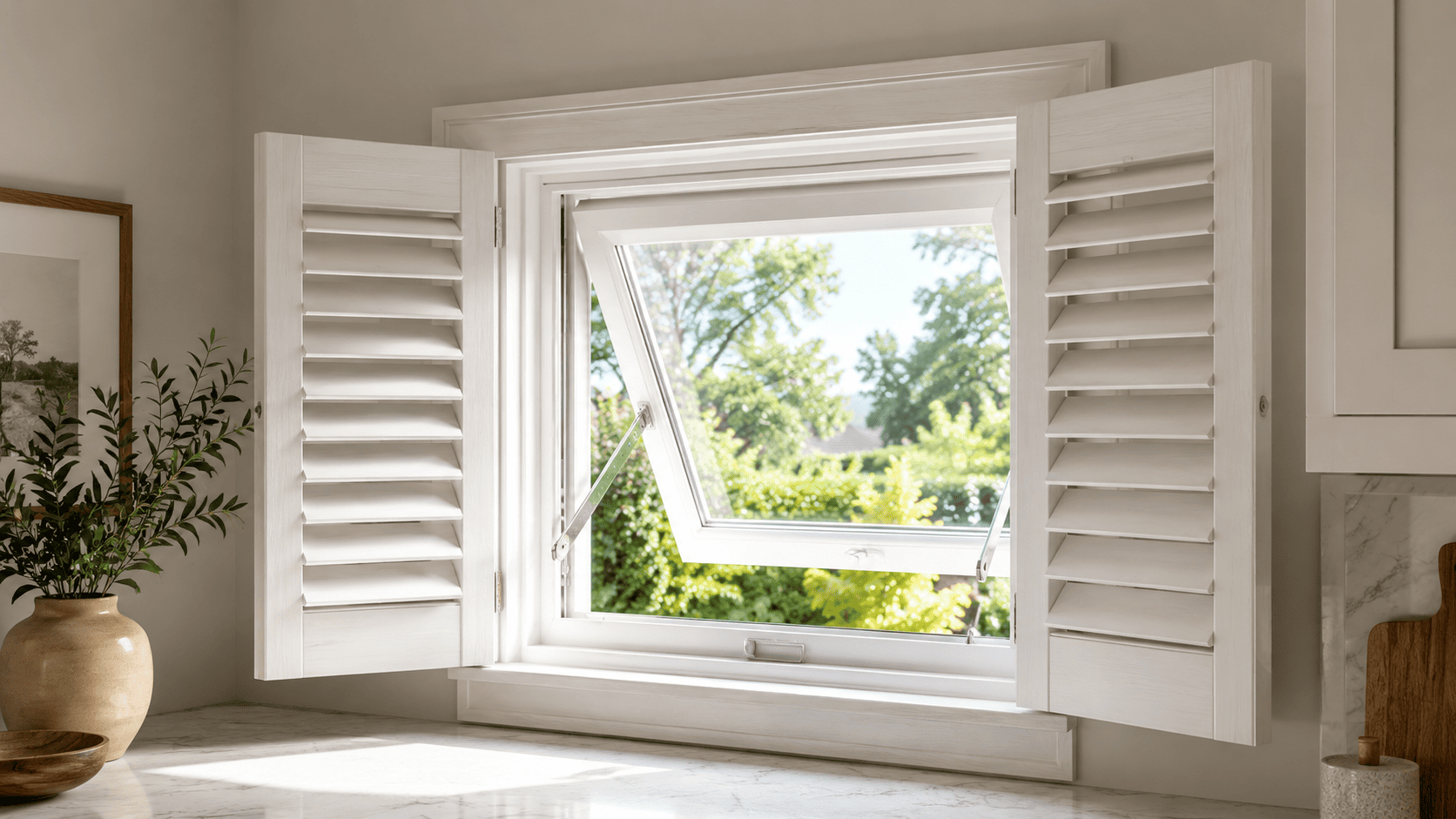
Awning Window Shutters: What to Check Before Choosing a Custom Fit
Author: Nigel Harris.
July 27, 2026.
Awning windows offer practical ventilation in a compact design. Because they are hinged at the top and open outward from the bottom, you can often let fresh air into a room while limiting direct exposure to light rain. Their operating style, however, creates a few details you need to consider before adding awning window shutters.
The position of the crank or handle, the depth of the window opening, the location of the screen, and the way you access the window can all influence the shutter design. A custom fit accounts for these elements so the shutters look integrated with the window and remain practical to use.
This guide explains what to check when considering shutters for awning windows and how a carefully planned configuration can support privacy, light control, ventilation, and everyday operation.
Can You Open an Awning Window With Shutters Installed?
Yes, in many cases you can continue opening an awning window after shutters are installed. The shutters need to be designed so that you can access the crank, latch, or handle without obstruction.
You will generally open the shutter panel before operating the window. Once the awning sash is open, you can adjust the shutter panel and louvers according to the airflow, privacy, and daylight you want.
The exact sequence will depend on the configuration. For example, a single-panel shutter may need to swing fully into the room, while a multi-panel layout may allow access by opening only the panel nearest the crank.
During planning, consider how often you use the window:
Frequent ventilation: Prioritize quick access to the handle and an easy panel-opening path.
Occasional ventilation: A larger panel may be acceptable if it supports a cleaner appearance.
Mostly light and privacy control: Louver accessibility may be more important than frequent access to the sash.
Emergency or required access: The complete opening and all applicable requirements must remain unobstructed.
A shutter should support the window’s purpose rather than turning an operable window into one you avoid using.
How Awning Windows Affect Shutter Design
Unlike a fixed window, an awning window includes moving components that you need to reach from inside the room. The sash usually opens outward, but its crank, lever, latch, or push bar remains on the interior side.
This means the window itself may not move toward the shutter, but its operating hardware can occupy some of the same interior space needed by the shutter frame, panels, or louvers.
The main design objective is therefore not simply covering the glass. It is creating enough clearance for the shutter to operate while keeping the window controls accessible.
Awning windows also vary considerably. Some are short and wide, some are installed high on a wall, and others are combined with fixed or operable windows in a larger opening. Each arrangement may require a different panel layout or mounting approach.
What to Check Before Choosing Awning Window Shutters
Several measurements and operational details influence whether the shutters should sit within the window opening or around it. Reviewing these factors early helps prevent awkward clearances and unnecessary restrictions.
Opening Style and Direction
Awning windows are hinged along the top edge and typically open outward from the bottom. Because the sash moves away from the room, it usually does not swing directly into an interior shutter.
You will still need to open or reposition the shutter panels before reaching the window controls. The design should make this sequence straightforward:
Open the shutter panel.
Access the window handle, latch, or crank.
Open the awning window outward.
Return the shutter panel to the position that provides the ventilation and light level you want.
A well-planned panel arrangement makes these steps feel natural rather than cumbersome.
Awning windows differ from shutters for casement windows, where the sash is hinged at the side. However, both window styles require careful attention to operating hardware and access.
Handle and Crank Clearance
The crank or handle is often the most important clearance point. Some handles sit nearly flush with the window frame, while others project farther into the room or rotate through a wider area.
Before choosing a configuration, check:
How far the handle projects from the window;
Whether the handle folds down when not in use;
The space required to rotate the crank;
Whether the handle is centered or positioned to one side;
Whether any locks or latches sit above or beside it.
A shallow recess may not provide enough space for the handle and an inside-mounted shutter frame. In that situation, outside mount shutters may provide the required clearance by positioning the shutter farther into the room.
The hardware should also remain comfortable to reach. A design that technically clears the crank but makes it difficult to turn is unlikely to work well in daily use.
Window Frame Depth
Frame depth determines how much room is available for the shutter frame, panels, louvers, hardware, window controls, and any screen.
Deeper recesses may support inside mount shutters, which sit within the window opening and create a streamlined appearance. Shallower openings may require an outside mount around the opening instead.
Depth should be checked at several points rather than assumed to be uniform. Trim, uneven surfaces, projecting hardware, or changes in the recess can reduce the usable space.
You also need enough room for the louvers to tilt without touching the glass, screen, handle, or window frame. This is especially important with larger louvers, which require a wider operating arc.
Screen Position and Access
Many awning windows include an insect screen on the interior side because the sash opens outward. The position of that screen can affect shutter placement.
Check whether the screen:
Sits flush with the surrounding frame;
Projects into the room;
Must be removed from inside;
Has tabs, clips, or handles that need clearance;
Requires regular access for cleaning.
Your shutter design should not permanently block a screen that may need to be removed. In some windows, opening the shutter panels provides sufficient access. In others, the mounting position may need to be adjusted.
Surrounding Trim and Wall Space
The casing and trim around your window can influence both fit and appearance. An outside mount may sit on the existing trim, around it, or on the adjacent wall, depending on the available surface and the proportions of the opening.
Consider whether the window is close to:
A corner;
A countertop or backsplash;
Built-in shelving;
A ceiling line;
Another window;
A door frame;
Cabinets or furniture.
These elements can affect how far the shutter panels are able to open. They may also influence the number of panels and the direction in which those panels should move.
Furniture and Everyday Access
Awning windows are often installed above counters, bathroom fixtures, basement walls, or furniture. Even when there is enough room to install shutters, you need to consider how you will reach and operate them.
A panel that opens toward a faucet, shelf, or tall piece of furniture may be inconvenient. Likewise, a high window may require a configuration that allows you to adjust the louvers without frequently opening the entire shutter.
The right solution should reflect how often you open the window, why you use it, and what sits immediately in front of it.
Read also:
Inside or Outside Mounts: Choose the Right Fit for Your Home
Shutter Styles: Bi-Fold, Tri-Fold & Single
Inside Mount vs. Outside Mount Shutters for Awning Windows
Mounting position affects clearance, proportions, and how the finished shutters relate to the surrounding trim. Neither option is automatically better for every awning window.
When Inside Mount Shutters May Work
Inside mount shutters sit within the window opening. They can create a neat, contained look when the recess is sufficiently deep and relatively square.
This approach may work when:
The window controls do not project too far into the room;
The screen leaves enough usable depth;
The louvers can tilt freely;
The recess provides a suitable installation surface;
The window opening is not significantly out of square.
Inside mounting can preserve the appearance of decorative trim because the shutters remain within the opening. However, the recess must be evaluated carefully. Even a small crank or screen projection can reduce the available depth.
When Outside Mount Shutters May Be More Practical
Outside-mounted shutters are positioned around the window opening rather than within it. This can create additional space between the shutter panels and the window hardware.
An outside mount may be preferable when:
The recess is too shallow;
The crank or handle projects beyond the frame;
The interior screen occupies most of the recess;
The opening has uneven edges;
The window trim provides a better mounting surface;
Additional clearance is needed for the louvers.
Because the shutter frame covers a larger area, its proportions should be planned in relation to the window trim, nearby walls, and other windows in the room.
How Custom Awning Shutters Can Be Configured
The best configuration depends on the width and height of the opening, the location of the controls, and how frequently you need full access to the window.
A custom design allows these details to be coordinated rather than forcing a standard panel arrangement onto the opening.
Panel Number and Opening Direction
A small awning window may work with a single shutter panel. A wider opening may feel more balanced and operate more comfortably with two or more panels.
Panel width matters because a very wide panel requires more room to swing into the room. Dividing the opening into narrower panels can reduce that projection, but it also introduces additional vertical lines across the window.
The panel layout should consider:
The proportions of the glass;
The position of the crank;
Nearby furniture or walls;
The view through the window;
Alignment with any mullions or structural divisions;
How far each panel can open.
Where possible, vertical shutter lines can be aligned with the existing window structure to create a more intentional appearance.
Louver Size and Clearance
Louver size influences both the view through the shutters and the amount of space required for operation. Larger louvers create broader sightlines when open, while smaller louvers introduce more horizontal lines.
For an awning window, louver size also needs to be evaluated against the available depth. The louvers should be able to tilt through their intended range without touching the screen, crank, glass, or surrounding frame.
The best option depends on the depth of the opening and the visual scale of the window rather than louver size alone.
Divider Rails and Control Zones
A divider rail separates the louvers into independently adjustable upper and lower sections. This can be useful when the window is tall enough to benefit from separate control zones.
For example, you might close the lower section for privacy while leaving the upper louvers open for daylight. On a short awning window, however, a divider rail may make the design feel unnecessarily busy.
The location of the rail should also relate to the window structure and operating hardware. It should not make the crank harder to see or reach.
Integration With Larger Window Arrangements
Some awning windows sit above or below a fixed window, while others form part of a grouped arrangement. In these situations, the shutter configuration should address the complete opening.
A continuous frame can sometimes create a more unified appearance, while separate shutter sections may provide more independent access. The appropriate option depends on the window divisions, overall dimensions, and the way each section operates.
The goal is to respect the original window proportions while keeping the awning section functional.
Where Interior Shutters for Awning Windows Work Well
Awning windows are used in many parts of the home, but the design priorities may change from one room to another.
Bathrooms
In a bathroom, shutters can support privacy and light control while allowing you to adjust ventilation. Moisture exposure, window depth, and the location of the window above a tub, sink, or counter should all be evaluated.
Basements
Awning windows are common in lower-level rooms because their short, wide proportions suit openings near the top of a wall. Basement window shutters can create a more finished appearance while controlling visibility from outside.
Because basement windows may be high or difficult to reach, panel size and louver access are particularly important.
Kitchens
An awning window above a sink or counter may provide useful ventilation, but the countertop can limit the space available for opening shutter panels. The panel direction and reach to the crank need to be tested against the depth of the counter.
High Wall Openings
Awning windows are sometimes placed above eye level to introduce daylight or ventilation. In this setting, consider how you will reach both the window controls and the shutters.
Depending on the height, the window may be opened infrequently while the louvers are adjusted more regularly. The configuration should reflect that pattern of use.
Questions to Review During an In-Home Shutter Consultation
An in-home shutter consultation allows the window, hardware, screen, trim, and surrounding space to be evaluated together. Rather than relying only on the visible glass dimensions, the consultant can check how every component operates.
Useful questions to review include:
Will the shutter be mounted inside or outside the opening?
Does the crank need additional clearance?
Can the screen still be removed?
How far will the shutter panels project when open?
Which direction should each panel move?
Can the louvers tilt fully?
Will nearby furniture, counters, or walls restrict access?
Should the shutter lines align with other windows in the room?
How often do you expect to open the awning window?
Accurate measurements are essential, but observation is equally important. Seeing the window operate can reveal clearance needs that may not be obvious from dimensions alone.
Read more:
6 Unexpected Ways Interior Shutters Add Home ValueHow Much Do Window Shutters Cost? Key Pricing Drivers Explained
Awning Window Shutters: Common Questions
Because awning windows operate differently from standard fixed windows, a few practical questions frequently arise before a custom design is selected.
Do Shutters Prevent an Awning Window From Opening?
They should not when the mounting position and panel layout have been planned correctly. You will normally open the shutter panel first, then operate the awning window using its crank or handle.
Can Shutters Be Installed Over an Interior Screen?
The answer depends on the screen’s position and the available depth. The shutter may sit in front of the screen, but you still need a practical way to remove or clean it. A projecting screen may also make an outside mount more appropriate.
Are Awning Window Shutters Always Outside-Mounted?
No. An inside mount may work when the recess provides enough depth for the shutter frame, louvers, screen, and operating hardware. Outside mounting is often considered when one or more of those elements reduce the available space.
Will the Crank Remain Accessible?
A custom design should account for the crank’s projection, position, and rotation. The panel opening and frame placement should allow you to reach and turn it comfortably.
Can Custom Awning Shutters Cover a Grouped Window?
Yes. Awning windows can be incorporated into a larger shutter design when they are combined with fixed or operable window sections. The panel and frame layout should follow the divisions of the complete window while preserving access to the awning section.
Plan Awning Window Shutters Around Everyday Use
The right awning window shutters should do more than fit the dimensions of the opening. They should work with the window’s operating style, provide appropriate clearance, and allow you to use the crank, screen, panels, and louvers without unnecessary effort.
A design consultant can evaluate the window depth, handle projection, screen position, surrounding trim, panel swing, and how often you open the sash. From there, they can recommend whether an inside or outside mount is more suitable and which panel configuration will feel most practical for the way you use the room.
Installation services are available, and your design consultant can help coordinate installation details as part of the overall project experience.