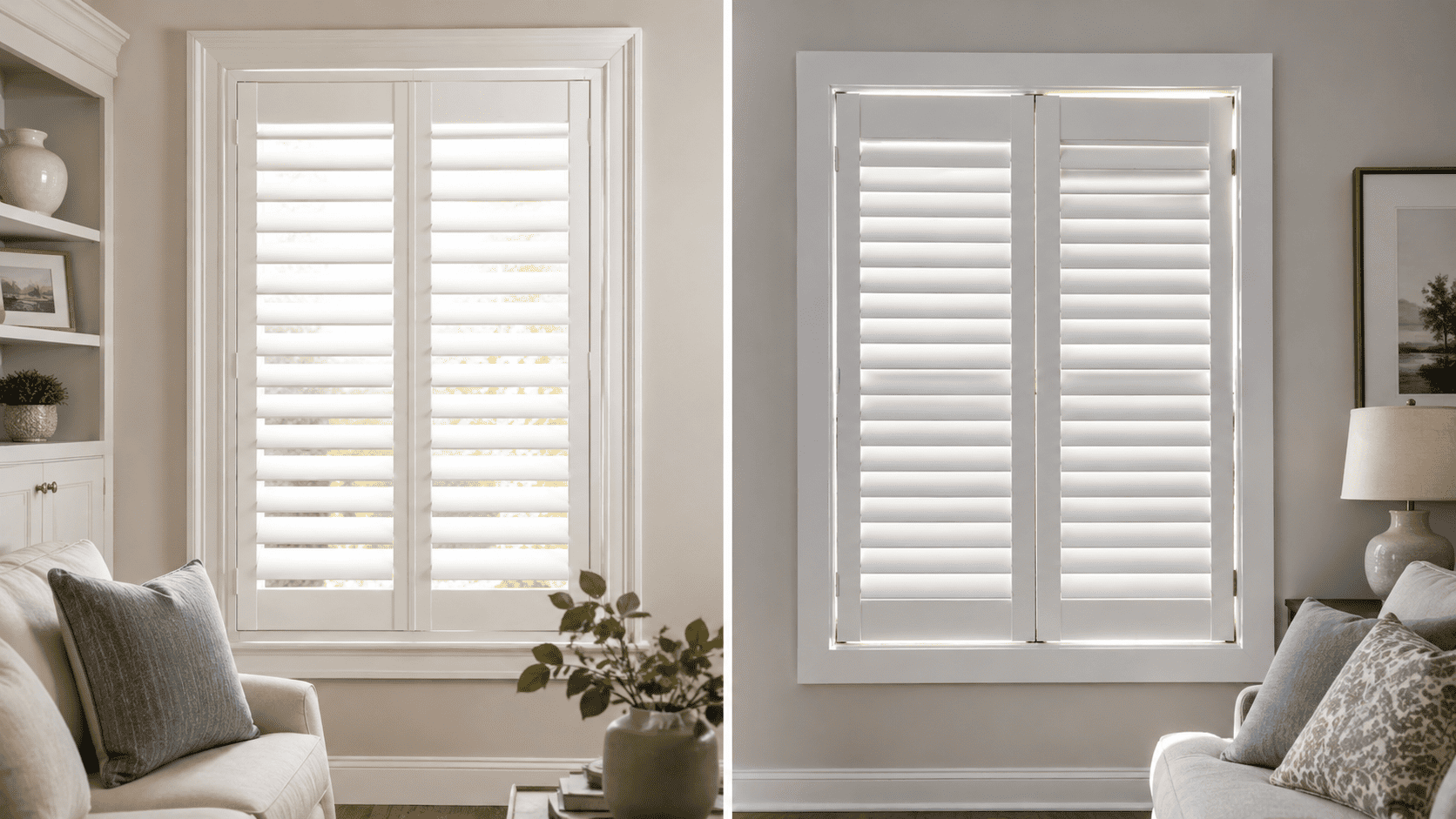
Made-to-Measure vs Ready-Made Shutters: What You Actually Gain
Author: Dan Williams.
July 27, 2026.
When you compare made-to-measure vs ready-made shutters, you are comparing two approaches to fit, design, operation, and long-term use.
Ready-made shutters come in predetermined sizes and configurations, while made-to-measure shutters are designed around the dimensions and conditions of your opening.
Custom shutters can be designed to fit virtually any window, while ready-made shutters may also work well for standard openings that closely match available sizes. The right choice depends on your window, design priorities, and how much customization you want in the finished result.
Made-to-Measure vs Ready-Made Shutters at a Glance
The differences become clearer when you compare the finished project rather than the product price alone.
What Are Ready-Made Shutters?
Ready-made shutters offer a standardized solution. You choose from the sizes, materials, colors, louver options, and panel arrangements already available.
This can simplify the decision, but it also means your window must work with the product rather than the product being designed around the window.
Standard Sizes and Fewer Choices
Ready-made shutters are created for rectangular openings that closely match a listed size. Even then, width and height are not the only measurements that matter.
A window may be slightly wider at the top than at the bottom. The recess may be shallow, while trim, handles, locks, cranks, sensors, or a projecting sill can reduce usable space. These details affect how evenly the frame sits, whether fillers are needed, and whether panels and louvers can move freely.
Ready-made does not necessarily mean poorly made. It means the product was designed for a range of openings rather than your specific window.
Standardized manufacturing generally makes ready-made shutters less expensive at purchase. The tradeoff is less control over frame proportions, panel divisions, louver size, material, finish, and hardware.
Extra fitting, framing, installation, or future replacement can also change the value of a lower-cost option.
What Are Made-to-Measure Shutters?
Made-to-measure shutters begin with the opening itself. Its dimensions, depth, trim, operating hardware, proportions, and location help determine the design.
During an in-home consultation, a specialist can measure the window, identify constraints, and recommend a suitable configuration. An internal shutters buyer’s guide can help you learn the main terms beforehand.
Measured for the Actual Opening
Windows are not always perfectly square. Width may vary from top to bottom, and available depth may change because of trim, sills, handles, or construction details.
A made-to-measure design uses the actual conditions of the opening rather than a nominal size. The frame and mounting method can then be selected according to the usable space.
This matters when comparing inside mount vs outside mount shutters An inside mount requires sufficient depth and clearance. An outside mount may work better when the recess is shallow or obstructed.
Configured Around Everyday Use
The shutters should not make the window harder to access. A custom panel layout can account for where the window opens, where its hardware is positioned, and how frequently you need to reach the glass.
The design may consider:
Where panels divide and which direction they open;
How panel lines align with window sections;
Whether locks and handles remain accessible;
Where privacy is most important;
How you want to direct daylight.
These choices support more natural operation.
Coordinated With the Room
Made-to-measure shutters give you more control over how the window relates to the room. Frame style, finish, panel proportions, and shutter louver size influence whether the result feels understated or visually substantial. Often, the best design follows the window’s existing lines and nearby finishes.
Read also:
How Much Do Window Shutters Cost? Key Pricing Drivers Explained
What to Expect During a Shutters Consultation and Measurement Visit
Made-to-Measure Shutters Benefits
The main made-to-measure shutters benefits are connected. A more accurate fit supports a cleaner finish, a thoughtful configuration improves operation, and greater design flexibility helps the shutters remain appropriate over time.
A More Precise and Integrated Fit
A custom design can account for openings that are uneven, unusually deep, shallow, narrow, wide, or affected by existing trim.
The design responds to those conditions before production, helping reduce uneven borders, awkward gaps, hardware interference, restricted louver movement, and poorly proportioned panels.
Fit also affects whether the shutters look integrated. Frame dimensions, panel divisions, and sightlines can be planned around the opening.
Greater Design Flexibility
Custom shutters may offer choices involving:
Frame and mounting style;
Number and arrangement of panels;
Louver size and divider rail placement;
Material, color, and finish;
Configurations for doors, bays, wide windows, and specialty shapes.
Material selection can influence appearance, weight, maintenance, and suitability for the room. A comparison of hardwood, faux wood, and composite shutters can help you understand those tradeoffs.
Technical limits still apply; not every configuration works in every opening.
Better Options for Difficult Windows
Arches, circles, triangles, angled windows, sidelights, doors, bays, and unusually large openings require more planning than a standard rectangle.
With specialty-shaped window shutters, the shape affects the frame, louver arrangement, operation, and visual balance. A custom design can follow the opening more closely instead of covering its architecture with a conventional rectangle.
Large windows and doors also need panel planning that balances appearance, access, and movement.
Professional Guidance
A made-to-measure project can include more support than selecting a product from a standard list.
During a shutter consultation and measurement visit, a specialist can explain relevant options and identify potential fit or operation issues before the order is placed. Similar-looking designs can function differently because of depth, hardware, or panel placement.
Installation services are available, and your design consultant will help coordinate installation details as part of the overall project experience.
Custom Shutters vs Ready Made: Where the Difference Matters Most
Custom shutters offer the flexibility to work beautifully across a wide range of window sizes, shapes, and layouts. Ready-made shutters can still be a practical option for simpler, standard openings, but custom designs provide greater control over fit, proportion, operation, and the finished look.
Nonstandard, Shallow, or Obstructed Openings
Made-to-measure shutters are usually the stronger option when the window does not match standard dimensions, is not square, has an unusual shape, or includes irregular trim and limited clearance.
A shallow frame may not leave enough room for a standard inside-mounted shutter. The frame, louvers, locks, handles, and distance from the glass all need to be considered. Professional measurement can identify the usable depth and whether another mounting approach would work better.
Large Windows, Doors, and Whole-Home Projects
Large openings require panel divisions that manage weight, proportions, and access. Doors must also account for handles, frequent movement, and traffic through the room.
Across several rooms, the windows do not need identical configurations, but frame style, finish, and louver proportions should feel connected. Planning shutters for a whole-home project can help determine what should remain consistent.
How to Compare Long-Term Value
Ready-made shutters usually cost less upfront. Made-to-measure shutters include measuring, design, individual production, and project coordination.
A fair comparison should consider the complete project and the compromises each option may require.
Compare the Full Project Cost
When researching how much window shutters cost, look beyond the price of one panel. The total can be affected by window size, material, finish, frame configuration, specialty shapes, installation, and additional fitting.
Ask what is included in each quote. A product-only price is not directly comparable with a project that includes professional measurement, design guidance, and installation coordination.
Consider the Cost of Compromise
A lower-priced shutter may still provide poor value if the fit bothers you, the panels restrict access, or the configuration does not manage privacy and daylight as expected.
Identify these compromises before ordering rather than after installation.
Made-to-measure shutters offer stronger long-term value when you expect to keep them for many years. That value comes from fit, practical operation, room-appropriate design, and compatibility with the window, not simply from the word “custom.”
When Ready-Made Shutters May Be Enough
Ready-made shutters can be practical when:
The window closely matches an available standard size;
The opening is rectangular, even, and sufficiently deep;
Trim and operating hardware are uncomplicated;
You need only a basic color and configuration;
Your main priority is reducing the upfront price;
The shutters are intended for a secondary or short-term space.
Measure more than the nominal width and height. A product that appears suitable on paper may still conflict with the recess, trim, or hardware.
Read more:
6 Unexpected Ways Interior Shutters Add Home Value
Top 10 Tips to Care for your Indoor Shutters
When Made-to-Measure Shutters Are Worth Prioritizing
Made-to-measure shutters are generally worth prioritizing when:
You want an integrated architectural finish;
The window is unusually shaped, sized, or uneven;
Handles, locks, trim, or sills affect the available space;
You need a specific panel or louver configuration;
You are covering a bay, door, or large opening;
You want coordinated shutters across several rooms;
You prefer professional measuring and design guidance;
You are making a long-term investment in the home.
The question is not whether customization is always better. It is whether a standard design can meet the real requirements of your window without creating compromises you will notice every day.
Questions to Ask Before You Decide
Before choosing between made-to-measure and ready-made shutters, ask:
Does the opening match a standard size at the top, middle, and bottom?
Is it square and deep enough for the proposed frame?
Will handles, locks, cranks, and sensors remain accessible?
Can the panels and louvers move freely?
Are the available materials, finishes, and layouts suitable?
What measuring, installation, and warranty services are included?
Would a lower price justify a less tailored fit or finish?
Your answers will show whether a standard product can meet your needs or whether a custom design is likely to provide meaningful value.
Choose the Solution That Fits Your Priorities
The central question in the made-to-measure vs ready-made shutters comparison is not simply which option is cheaper. It is which option will fit, function, and look the way you expect in that opening.
Ready-made shutters can work well when the window is straightforward and your requirements are simple. Made-to-measure shutters become more valuable when dimensions are unusual, clearances are limited, the window is prominent, or you want greater control over the final design.
An in-home consultation lets a consultant measure the opening, review constraints, recommend suitable configurations, and coordinate the next stages.
Schedule an in-home consultation to explore your options and decide whether a made-to-measure design offers the right balance of fit, flexibility, and long-term value for your home.