Shutter Panel Pulls: What They Are and When They Help
Author: Nigel Harris
August 24, 2026.
When you choose custom shutters, major decisions such as louver size, panel configuration, finish, and mounting method receive the most attention. Yet smaller hardware choices can influence everyday use.
Panel pulls provide a defined place to grasp a shutter panel when you want to swing it open or guide it closed. On the right window, that simple addition can make operation feel more intuitive without changing the overall look too much.
However, panel pulls are not necessary for every design. Some panels are already easy to handle from the edge, while some rooms benefit from keeping the shutter face simple. Understanding what panel pulls do—and what they do not do—can help you decide whether this shutter pull hardware belongs in your project.
What Are Panel Pulls on Shutters?
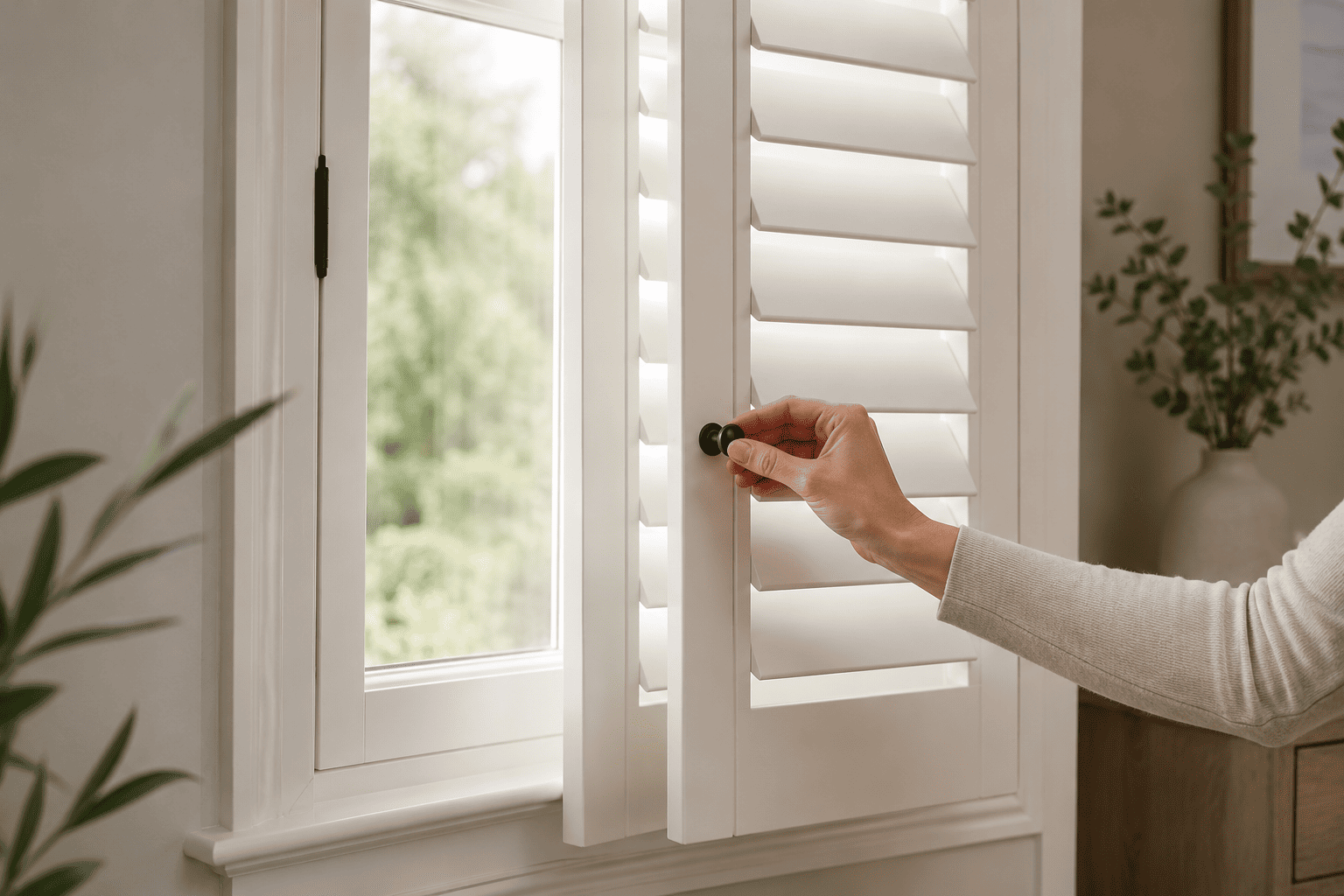
Panel pulls are small pieces of hardware attached to the front of an operable shutter panel. They act as a dedicated grip point, helping you move the panel away from the window or guide it back toward the frame.
A pull may resemble a compact knob, ring, tab, or low-profile handle. The shape can vary, but its purpose remains the same: it helps you operate the panel itself.
Where Shutter Panel Pulls Are Positioned
Shutter panel pulls are generally placed on a solid vertical stile rather than on a moving louver. The position should be easy to reach and visually balanced with the panel.
A pull that sits too high, too low, or too close to another hardware element may feel awkward. On a custom design, its location can be considered alongside panel height, rails, hinges, and the way neighboring panels meet.
How Panel Pulls Differ From Louver Controls
A panel pull opens the full hinged panel. It does not tilt the louvers.
Louvers are the horizontal slats that rotate to manage daylight, privacy, and outward view. Adjusting them changes what passes through the shutter; opening the panel moves the entire shutter section away from the glass.
If you are learning the basic parts of interior shutters, understanding what a louver is makes the distinction clear: the louver manages light and privacy, while the panel pull moves the larger framed panel.
How Shutter Panel Pulls Affect Daily Use
The value of panel pulls is not about adding a dramatic feature. It is about making a repeated movement clearer. Whenever you open a panel for window access, ventilation, cleaning, or an unobstructed view, the pull gives your hand a predictable place to go.
A Consistent Place to Grip the Panel
Without a pull, you may grasp the stile or outer edge. That can work well, particularly on a smaller panel with an accessible edge.
A pull creates a more obvious operating point. You do not need to reach between panels or decide where to place your fingers. In a multi-panel configuration, matching pulls can also show which sections are intended to swing open.
This may help guests or family members understand how the panel should be handled.
Less Routine Contact With the Louvers
Without a defined grip point, you may be tempted to press a louver or use the louver control to move the panel. Those parts are intended to adjust the slats, not act as handles for the full panel.
A panel pull encourages you to use a solid point and can reduce routine contact with the louvers, helping limit fingerprints or smudges. It does not eliminate normal cleaning; it simply supports more consistent handling.
More Convenient Access to the Window
You may open shutter panels to reach a latch, operate a crank, bring in more air, clean the glass, or temporarily clear the view. When these actions are part of the room’s routine, a pull can add useful convenience.
Panel width, weight, hinges, nearby furniture, recess depth, and hand clearance still influence operation. A pull provides a grip point, but easy use begins with a properly planned and fitted shutter.
Read also:
Shutter Styles: Bi-Fold, Tri-Fold & Single
Using Shutters to Cover your Specialty Shaped Windows
When Panel Pulls Help Most
There is no rule that every shutter should have pulls. Their usefulness depends on the opening, panel design, and how you expect to use the window.
Tall or Substantial Panels
A taller or wider panel may feel more substantial than a compact one. A well-positioned pull gives you a clear place to guide it through its swing.
The pull does not change the panel’s weight or correct an unsuitable configuration. Panel sizing, hinges, and support still need to work for the opening. The hardware simply makes hand placement more deliberate.
Windows You Open Regularly
Panel pulls can be practical when the shutters must swing open often because you regularly operate the window behind them.
This may include windows opened for fresh air, casement windows with cranks, windows with frequently used locks, or glass that needs regular access. In these situations, you are repeatedly moving the full panel rather than only tilting the louvers.
The design should also account for whether an inside or outside mount provides enough clearance for the shutters, window hardware, trim, and surrounding area.
Multi-Panel Shutter Configurations
Wide openings may use several panels. Pulls can provide a consistent operating point on the sections designed to open.
Their placement should be planned so the center of the window does not look crowded. Pull size, distance from the edge, and relationship to neighboring hardware all affect the appearance. When proportioned well, the pulls clarify operation without becoming dominant.
Openings With Limited Edge Access
Deep recesses, nearby walls, furniture, or the way two panels meet can make an edge less convenient to grasp. A pull may create a more accessible point on the face of the panel.
It cannot solve blocked movement. If a counter, sofa, faucet, or wall prevents the shutter from opening, added hardware will not remove the obstruction. The full swing path still needs to be reviewed.
When You Prefer a Defined Handhold
Some people prefer the feel of a small knob or ring instead of grasping a flat edge. A defined grip may feel more comfortable or intuitive.
Reach and dexterity vary, so panel pulls should not automatically be treated as an accessibility solution. During an in-home design consultation, you can review the position and determine whether the hardware genuinely improves use in your home.
When Shutter Panel Pull Hardware May Be Unnecessary
Panel pulls add function, but they also add a visible detail. In some designs, leaving them off creates a better balance.
Small Panels That Are Easy to Handle
Compact panels may already be easy to open from the stile or edge. When the natural grip point is obvious and comfortable, a separate pull may offer little practical benefit.
This is common on smaller openings where your hand can reach the edge without squeezing between sections or touching the louvers. The choice may then be mostly aesthetic.
Panels That Rarely Swing Open
Many people control light and privacy by tilting the louvers while leaving the panels closed within the frame. If that matches your expected use, the pulls may receive little attention.
You will still open the panels occasionally for cleaning or window access. The question is whether those infrequent moments justify another visible hardware element.
Minimal or Low-Profile Rooms
A panel pull can be subtle, but it still adds detail to the shutter face. If you want a restrained, architectural appearance, you may prefer to operate the panel from its edge.
That approach works best when the edge is comfortable to reach. A minimal look should not make everyday operation inconvenient.
How Panel Pulls Influence the Overall Look
Custom shutters become part of the architecture around the window, so small hardware choices should relate to the full composition. Scale, finish, shape, and placement determine how noticeable panel pulls become.
Size and Proportion
A large pull can overpower a narrow stile or small opening. A very small pull may be difficult to grip or look undersized on a substantial panel.
The pull should be considered against the full panel, not only as an isolated sample. The same hardware may look discreet on one shutter and prominent on another.
Finish and Contrast
Hardware can blend with the shutter finish or create contrast. A coordinated finish keeps the pull visually quiet, while a contrasting finish makes it more noticeable.
The right choice depends on whether you want the hardware to recede or relate to door hardware, cabinet pulls, and light fixtures. Exact matching is not always necessary, but the elements should feel deliberate together.
Alignment Across Multiple Panels
When several pulls appear in one opening, consistent placement becomes important. Small differences are easier to notice when hardware repeats across a wide window.
The pulls should relate to the rails, panel meeting points, and one another. Some configurations benefit from symmetry, while others require hardware only on selected operating panels.
Read more:
6 Unexpected Ways Interior Shutters Add Home Value
Top 10 Tips to Care for your Indoor Shutters
Panel Pulls vs Other Shutter Hardware
Shutter panel pulls are only one part of the operating system. Each component performs a different job.
Panel Pulls vs Tilt Controls
Panel pulls swing the full panel. Tilt controls rotate the louvers.
If your goal is to adjust daylight or privacy, focus on louver operation. If your goal is easier access to the window behind the shutter, a panel pull may be more relevant.
Panel Pulls vs Hinges
Hinges support the panel and allow it to swing. Panel pulls provide a place for your hand to guide that movement.
A pull cannot compensate for poor alignment, incorrect hinge selection, or insufficient support. Smooth operation depends on the full design working together.
Panel Pulls vs Panel Locks
A panel lock helps hold or secure a shutter panel in a closed position. A panel pull helps you move the panel by hand.
The two features solve different problems. Availability and compatibility can vary, so the combination should be confirmed within the custom specifications.
What to Consider Before Adding Panel Pulls
Before selecting panel pull shutters, focus on how the window functions rather than choosing hardware only because it looks attractive in a sample.
Ask:
How often will you swing the panels open?
Can you comfortably grasp the panel edge?
Is the opening tall, wide, recessed, or partly obstructed?
Will several pulls look balanced or visually busy?
Should the hardware blend with the shutter or coordinate with the room?
Is the proposed location comfortable for regular users?
Does the pull work with the panel configuration, frame, and mount?
These questions are easiest to answer in the room because reach, clearance, scale, and finish can look different at the actual window. A design consultant can show which custom shutter options suit the opening and position the hardware within the complete design.
A Small Detail That Can Improve Everyday Use
Panel pulls provide a dedicated grip point, reduce the temptation to handle the louvers, and make the panel-opening motion more obvious. They are most useful on frequently opened shutters, larger configurations, and openings where the edge is less convenient to grasp.
They may be unnecessary on compact panels or where a minimal shutter face is the priority. The right choice depends on how you use the window, how the panels are configured, and how visible you want the hardware to be.
By considering panel pulls as part of the complete design—not as an isolated accessory—you can decide whether this modest detail will make daily operation feel more natural