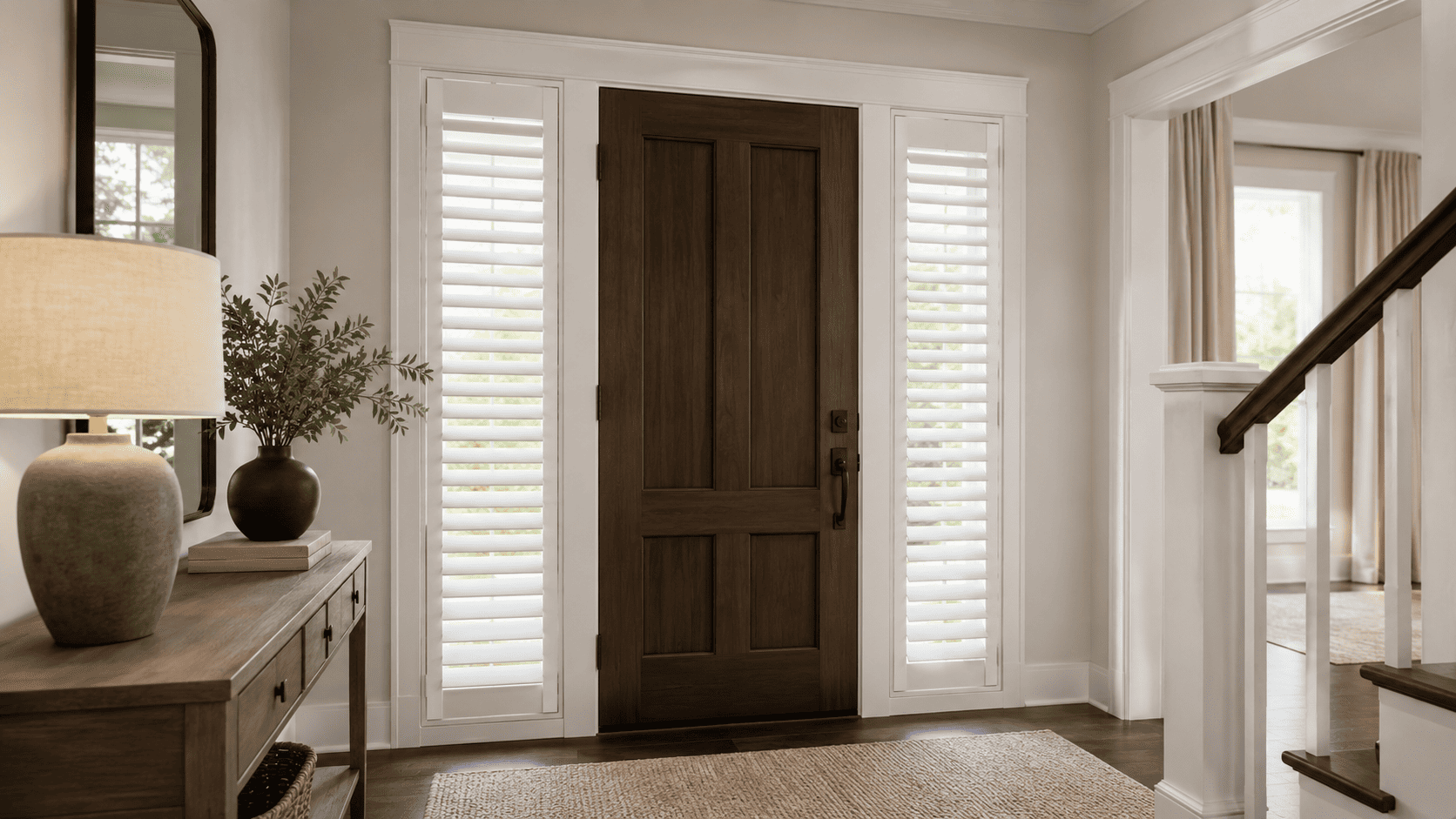
Entry Door Sidelight Shutters: Privacy Options for Narrow Windows
Author: Nigel Harris
September 1, 2026.
Sidelight windows bring natural light into your entryway but can also create a direct view into your home. Entry door sidelight shutters provide adjustable privacy while preserving daylight.
Because these windows are narrow, panel size, louver proportions, mounting depth, hardware, and trim must be carefully considered to achieve a clean, balanced fit.
Why Privacy Matters Around Entry Door Sidelights
Your entry is one of the most visible areas of your home. Depending on the position of the sidelight, someone standing on the porch may be able to see into a hallway, living room, staircase, or another frequently used space.
Visibility may become even more noticeable after dark, when indoor lighting makes an uncovered interior easier to see from outside. Fully covering the glass can improve privacy, but you may still want daylight during the morning or afternoon.
Adjustable shutters provide more control over both conditions. You can tilt the louvers to reduce a direct sightline, close them when you want greater privacy, or open them when you want more natural light and a clearer view of the entrance.
This combination of privacy and light control is one of the main reasons shutters work well beside an entry door.
Do Shutters Work on Sidelight Windows?
Yes, shutters can be designed for many sidelight windows, including narrow, tall openings and entries with glass on one or both sides of the door.
The key is using a made-to-measure design. Small differences in width, depth, trim, or alignment can become highly visible on such a narrow opening. A custom measurement allows the shutter frame and panel to follow the actual dimensions of the sidelight rather than relying on a standard size.
Custom entry door sidelight window shutters can also account for:
Shallow window recesses
Decorative door and window trim
Projecting handles or lock hardware
Nearby walls or corners
Baseboards and flooring transitions
The direction in which the door and shutter panels open
Differences between the left and right sidelights
A design consultant can evaluate these conditions in your home and determine whether the proposed shutter configuration will have enough space to fit and operate comfortably.
Read also:
7 Benefits of Shutters for Your Home
Using Shutters to Cover your Specialty Shaped Windows
How Entry Door Sidelight Shutters Control Privacy and Daylight
Sidelights often bring useful daylight into an area that might otherwise feel enclosed. The goal is usually not to eliminate that light, but to manage it more effectively.
Several shutter design elements influence the balance.
Adjustable Louvers
Adjustable louvers let you change the angle of the opening throughout the day. Instead of choosing between fully exposed glass and complete coverage, you can reposition the louvers according to the light level and the amount of privacy you need.
For example, you may keep the louvers partially open during the day, then close them when the entry is illuminated at night. You can also adjust them to reduce a particular exterior sightline while continuing to admit some daylight.
Full-Height Coverage
Full-height shutters cover the sidelight from top to bottom, creating consistent privacy across the entire glass area.
This approach is especially useful when the sidelight begins close to floor level or provides a direct view into an adjoining room. It also creates a more architectural look than a covering that occupies only part of the opening.
Hinged Panel Access
Although many sidelights contain fixed glass, a hinged shutter panel can still be useful. Opening the panel gives you easier access to the glass for cleaning and provides an unobstructed view when needed.
The available panel swing should be considered before the shutters are ordered. A panel that opens into a wall, door handle, piece of furniture, or busy walkway may be less practical in everyday use.
Proportion Matters on Narrow Sidelight Windows
A sidelight shutter should look like it was designed specifically for the entrance. On a very narrow window, small design decisions can significantly affect the final appearance.
Keep the Panel Layout Simple
In many entries, a single full-height panel creates the cleanest result, provided the opening dimensions and product specifications support that configuration.
Dividing a narrow sidelight into multiple vertical panels can introduce too many stiles and frames, leaving less visual space for the louvers. A simpler layout usually helps the glass and shutter appear taller and less crowded.
For exceptionally tall openings, the design may require additional structural considerations. Your consultant can determine which panel arrangement will maintain appropriate proportions and dependable operation.
Choose a Proportionate Louver Size
The right louver size depends on the width and height of the sidelight, the preferred view through the glass, and the visual relationship with other shutters in your home.
Very large louvers may feel visually heavy within an especially narrow panel. Smaller or medium-sized louvers can sometimes create a more balanced appearance, although the best option should be evaluated against the actual opening.
The shutter should also coordinate with nearby architectural details. If you already have shutters in an adjoining room, using a related louver size and finish can make the entrance feel connected to the rest of the interior.
Avoid an Overly Heavy Frame
The frame provides the mounting surface and gives the installation a finished edge, but it also occupies part of the visible opening.
On a narrow sidelight, a frame that is too prominent can make the shutter feel compressed. The frame style should provide the necessary fit and coverage without overwhelming the panel.
This is one reason an accurate in-home assessment matters. The design must balance the visible shutter proportions with the practical space required for mounting and operation.
Inside or Outside Mount Shutters for Sidelights
Choosing an inside or outside mount is one of the most important fitting decisions for shutters for sidelight windows.
Inside Mount
An inside mount positions the shutter frame within the sidelight recess. It can create a compact, integrated appearance and may allow the surrounding trim to remain visible.
An inside mount may be suitable when:
The recess has enough usable depth
The interior surfaces provide a suitable mounting area
There are no sensors, handles, or other obstructions
The opening is sufficiently square and consistent
The louvers and panel can operate without contacting the glass or hardware
Because sidelights can have shallow frames, an inside mount is not always possible. Even when there appears to be space, the required louver clearance and frame depth must also be considered.
Outside Mount
An outside mount positions the shutter frame on the trim or another surface surrounding the opening. This approach can accommodate a shallow recess and may provide more flexibility around obstructions.
An outside mount may make sense when:
The sidelight has limited mounting depth
Interior trim reduces the usable opening
Hardware or sensors occupy the recess
Additional coverage is needed around the glass
The surrounding surface provides a more stable mounting location
The outside frame should be proportioned carefully so it does not compete with the front door trim. Your consultant can review frame samples and placement options to find an arrangement that feels integrated rather than added on.
Check Door Hardware and Panel Clearance
The sidelight and front door function as one architectural composition, but they contain separate moving parts. The shutter design needs to account for how those elements interact.
Before selecting a panel configuration, review:
Whether the front door swings inward or outward
How far the door handle or lever projects
Whether the shutter panel will open toward the door
The location of locks, security sensors, switches, or alarm components
The space between the sidelight and an adjacent wall
Whether furniture, rugs, or décor occupy the panel’s opening path
The shutter panel does not necessarily need to remain open for you to control light. You can adjust the louvers while the panel stays closed. However, adequate swing clearance is still valuable for cleaning, maintenance, and full access to the glass.
Choosing Front Door Sidelight Shutters for One or Two Windows
Entry configurations vary. Some doors have a single sidelight, while others have matching windows on both sides. The best visual approach depends on the arrangement.
A Single Sidelight
With one sidelight, the shutter should feel connected to the door rather than visually isolated. Frame width, color, panel height, and louver proportions should complement the surrounding trim and door style.
The shutter does not need to match the door color exactly. A finish that coordinates with the interior molding or other custom interior shutters may create a more cohesive transition into the home.
Two Sidelights
When the door has sidelights on both sides, consistency becomes especially important. The shutter panels should align visually, with matching frame details, louver sizes, and horizontal reference points wherever the openings allow.
The two windows should still be measured individually. Construction variations can mean one opening is slightly different from the other, even when they appear symmetrical. Custom fabrication can accommodate these differences while preserving a balanced finished appearance.
If one side contains an obstruction or requires a different mounting condition, the design should minimize any visible inconsistency from the center of the entry.
Coordinate the Shutters With the Door and Entryway
Front door sidelight shutters become part of the first interior impression of your home. Their finish and frame details should work with the door, flooring, wall color, trim, and nearby furnishings.
Consider whether you want the shutters to:
Blend into white or neutral trim
Coordinate with existing wood tones
Create contrast against a painted door
Match shutters used in nearby rooms
Make the entrance feel more traditional or streamlined
Consistency does not require every element to be identical. The goal is to create a clear relationship between the shutter, the architecture, and the rest of the interior.
If you are also considering shutters for doors or nearby windows, reviewing the full entry area during the same consultation can help establish a more unified design.
Why a Custom Fit Is Important for Narrow Windows
Narrow openings leave little room for measurement errors. A small variation that might be less noticeable on a wide window can affect the alignment, louver clearance, frame coverage, or visual balance of a sidelight shutter.
Custom measurements also allow the design to respond to openings that are not perfectly square. Rather than assuming both vertical sides are identical, the consultant can evaluate the sidelight at multiple points and plan the frame around the actual conditions.
A custom fit can help the shutters:
Follow the proportions of the glass
Avoid unnecessary gaps or oversized framing
Operate around nearby door hardware
Coordinate across two sidelights
Maintain a finished appearance from inside the entry
Provide practical access to the glass
The result should feel like an architectural part of the entrance rather than a separate element placed over the window.
What to Expect During Your In-Home Consultation
During an in-home consultation, your design consultant can inspect the sidelight, take detailed measurements, and review the practical requirements of the entry.
The consultation may include:
Measuring each sidelight individually
Confirming the available mounting depth
Reviewing inside- and outside-mount possibilities
Checking door, handle, trim, and panel clearance
Comparing frame and finish samples
Discussing louver proportions
Coordinating one or two sidelight panels
Reviewing privacy priorities and preferred operation
This is also an opportunity to see how the proposed finish responds to the actual lighting, door color, and trim in your home.
Installation services are available, and your design consultant will help coordinate installation details as part of the overall project experience.
Read more:
Sliding Glass Door Shutters: Bypass vs Bi-Fold Options Explained
Transom Window Shutters: Options for Windows Above Doors and Large Openings
Create a More Private and Balanced Entrance
Entry door sidelight shutters can reduce unwanted visibility while preserving the daylight that makes your entrance feel open and inviting. They can also bring greater visual structure to narrow windows that might otherwise feel disconnected from the door.
The most successful design considers more than the dimensions of the glass. Panel proportions, louver size, frame placement, mounting depth, door hardware, and symmetry all contribute to the finished result.
A custom in-home assessment can help you determine which configuration gives you the privacy, operation, and appearance you want without making the entrance feel crowded. Schedule a free in-home design consultation to explore a sidelight shutter design tailored to your door and entryway.
Frequently Asked Questions About Entry Door Sidelight Shutters
Can shutters be fitted to very narrow sidelights?
Many narrow sidelights can accommodate custom shutters, but feasibility depends on the usable width, mounting depth, frame requirements, and minimum panel specifications. An in-home measurement is the best way to confirm the available options.
Will shutters make my entryway too dark?
Not necessarily. Adjustable louvers let you admit daylight without leaving the entire sidelight exposed. You can change the louver angle as lighting and privacy needs change throughout the day.
Do sidelight shutter panels need to open?
The louvers can usually be adjusted while the shutter panel remains closed. A hinged panel is still useful when you need full access to the glass for cleaning or an unobstructed view. The panel’s opening path should be evaluated during the design process.
Can shutters interfere with the front door?
A properly planned installation should account for the door swing, handles, locks, trim, nearby walls, and shutter panel movement. These clearances should be checked before the order is placed.
Should shutters on two sidelights be identical?
They should generally coordinate in panel height, finish, frame details, and louver alignment. However, each opening should be measured separately so small construction differences can be accommodated without compromising the balanced appearance.