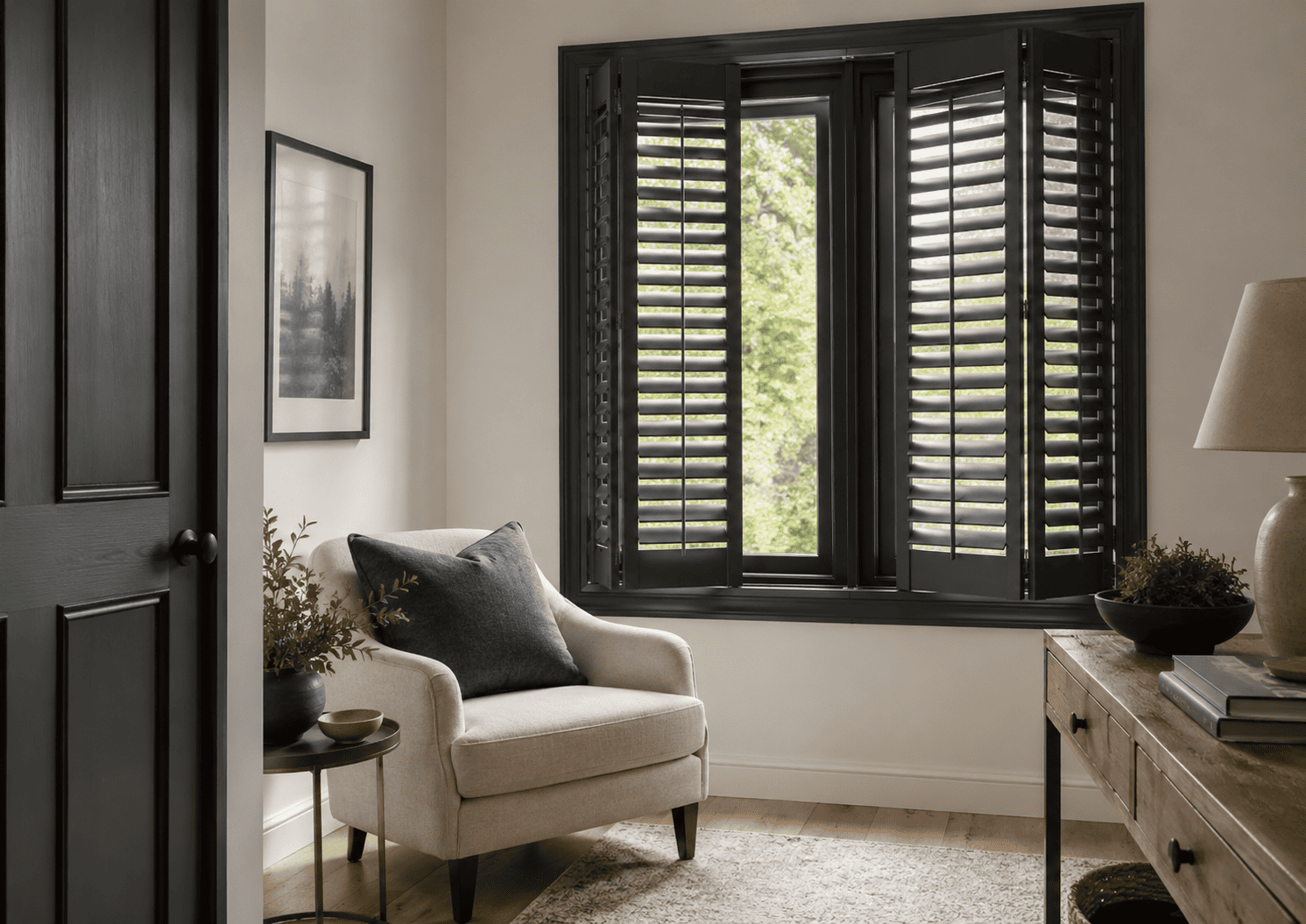
Dark Shutters in Small Rooms: When They Work and What to Watch
Author: Nigel Harris
September 2, 2026.
Dark shutters can give a room definition, contrast, and architectural character. In a compact space, however, the same finish can feel more prominent because the window occupies a larger share of your field of view.
That does not mean you need to avoid dark shutters in small rooms. The result depends on more than square footage. Natural light, wall color, window size, finish, louver proportions, and the amount of contrast around the opening all influence whether the shutters feel deliberate or visually heavy.
When these elements are considered together, dark interior shutters can make a smaller room feel refined, comfortable, and distinctive rather than closed in.
Can Dark Shutters Work in a Small Room?
Yes. Dark shutters can work successfully in a small room when they support the room’s overall design instead of competing with it.
A darker finish naturally draws attention to the window. This can be an advantage when the window has attractive proportions or you want it to become a defined architectural feature. It may be less successful when the room already contains several dark surfaces or receives very little daylight.
Before choosing the finish, consider three basic questions:
Does the room receive enough natural or artificial light to support a strong contrast?
Will the shutters coordinate with other permanent details, such as flooring, trim, doors, or built-in cabinetry?
Do you want the window to become a focal point or blend quietly into the surrounding wall?
The goal is not always to make a small room look as large as possible. A darker palette can also make a compact office, bedroom, reading room, or dining area feel more intimate and intentional.
What Helps Dark Shutters in Small Rooms Feel Balanced?
The finish itself is only one part of the design. Small room dark shutters tend to look most balanced when light, proportion, and surrounding surfaces are planned as a complete composition.
Start With the Room’s Natural Light
A small room with a bright window may support dark shutters more easily than a larger room with limited daylight. Strong natural light creates contrast and helps the louvers remain visually defined, even when the finish is deep charcoal, brown, or black.
Window direction also matters. A room that receives direct daylight for several hours may feel noticeably different from one with a shaded or north-facing exposure. Evaluate the finish at the times when you use the room most often rather than relying on how it looks under showroom lighting.
Louver position will also change the effect. Open or angled louvers can introduce light between the darker surfaces, reducing their visual weight. Understanding how louvers control light can help you decide whether a bold color will remain practical throughout the day.
Choose a Finish That Adds Depth, Not Glare
Dark does not have to mean flat black. Charcoal, espresso, deep gray, muted navy, and stained wood tones can add depth while maintaining a softer relationship with the rest of the room.
The sheen of the finish also affects the result. A lower-sheen surface usually appears quieter and more architectural, while a highly reflective finish may create stronger highlights and make the window feel busier.
Pay attention to undertones as well. A warm dark brown may coordinate naturally with wood floors and cream walls, while a cooler charcoal may work better with crisp whites, gray stone, or cool-toned furnishings. The right undertone makes dark shutters feel connected to the room rather than added as an isolated feature.
Use Louver and Panel Proportions Carefully
Every line becomes more visible in a dark finish. The size of the louvers, number of panels, frame profile, and vertical divisions can therefore have a greater impact in a compact room.
Larger louvers may create a cleaner, less segmented appearance, depending on the dimensions and configuration of the window. Smaller louvers introduce more horizontal lines, which may suit a traditional room but can appear visually active on a dark surface.
Panel count should also respond to the width of the opening. Adding more divisions than necessary can make the installation look crowded. Reviewing suitable shutter panel styles can help you understand how each configuration affects both operation and visual rhythm.
Read also:
White Window Shutters: Why They Still Look Modern and Premium
Are Black Shutters a Good Idea? When They Work (and When They Don’t)
Dark Interior Shutter Colors That Suit Small Spaces
The best dark finish depends on the colors already present in the room. Rather than selecting a color in isolation, compare it with the walls, flooring, trim, furniture, and nearby door finishes.
Soft Black and Charcoal
Soft black and charcoal create clear definition without the severity of a pure, highly saturated black. These colors work particularly well in modern, transitional, or monochromatic interiors.
They may coordinate with:
Black window frames or door hardware
Charcoal furniture or stone
White, off-white, or pale gray walls
Simple architectural trim
Warm wood accents that soften the contrast
Using the same dark color in a few small details elsewhere in the room can make the shutters feel integrated. Repeating it in a picture frame, lamp base, cabinet handle, or decorative object is often enough.
Deep Brown and Stained Wood
Dark brown or stained wood shutters can bring warmth to a small space. Instead of creating a sharp graphic contrast, they introduce natural variation and visual depth.
These finishes may work especially well with warm neutrals, traditional millwork, wood flooring, leather details, or rooms designed to feel cozy. Because visible wood grain breaks up the surface, a stained finish may feel less solid than an opaque dark paint color.
Avoid trying to match every wood tone exactly. A finish that shares a similar warm or cool undertone may look more natural than one that almost matches the floor or furniture but is slightly different.
Dark Gray, Navy, and Other Muted Tones
Dark gray, blue-gray, and muted navy can offer a middle ground between a neutral finish and a stronger color statement. They may read as dark during the evening but reveal more color in daylight.
These tones can work well when you want the shutters to feel distinctive without introducing the full contrast of black. They are most effective when the undertone appears elsewhere in the room, such as in upholstery, artwork, cabinetry, or painted walls.
Room Details That Support Small Room Dark Shutters
The surrounding design determines how much visual weight the shutters carry. You do not need to make everything else white, but maintaining enough contrast and open space around the window can keep the room balanced.
Consider the following details:
Wall color: Light or mid-tone walls create separation around dark shutters. Dark walls can also work, but they produce a more immersive and enclosed effect.
Window trim: Matching the shutter frame to the shutters creates a unified border. Contrasting trim outlines the installation more clearly.
Flooring: Pale or medium flooring can offset a dark window treatment, while dark flooring may require lighter walls or furniture for balance.
Furniture scale: A few appropriately scaled pieces generally feel calmer than several small items surrounding the window.
Textiles and upholstery: Light or textured fabrics can soften the defined lines of dark shutters.
Mirrors and reflective surfaces: Strategically placed reflective details can distribute light without making the room feel overly decorated.
Artificial lighting: Layered ceiling, wall, and task lighting can keep the room comfortable after sunset, when dark surfaces become more visually prominent.
Leaving some visual breathing room beside the window is equally important. Tall furniture, dense wall décor, or multiple contrasting finishes immediately around the opening can compete with the shutters.
When Dark Shutters Can Make a Small Space Feel Too Heavy
Dark shutters may not be the strongest choice for every compact room. The risk increases when several conditions occur at the same time.
Be more cautious when:
The room receives very little daylight.
The window fills most of a short wall.
The walls, flooring, furniture, and cabinetry are already dark.
The opening requires several narrow panels or prominent frame divisions.
The ceiling is low and the room has limited artificial lighting.
You want the window treatment to remain almost unnoticed.
Adjacent rooms use a much lighter and more open design language.
In these situations, a medium-tone finish may preserve some contrast without creating as much visual weight. Another option is choosing a dark color with softer undertones rather than the deepest available shade.
The answer is not necessarily to remove all dark elements. Instead, decide which feature should carry the strongest visual emphasis. When the shutters are the focal point, other major surfaces may need to remain quieter.
Read more:
How to Clean Shutters (and What to Avoid)
From Consultation to Installation: What to Expect and Typical Timelines
How Mounting and Fit Affect the Final Look
Dark finishes make edges and alignment easier to notice. A precise fit helps the installation look architectural, while unnecessary bulk or awkward transitions may become more obvious than they would with a lighter finish.
Keep the Window Area Visually Clean
Whether you use an inside or outside mount can influence how large the shutters appear in relation to the wall.
An inside mount may create a more contained look when the window depth and surrounding components allow it. An outside mount may be appropriate when the opening is too shallow or contains obstructions, but its frame occupies more of the visible wall area.
Neither approach is automatically better for a small room. The correct choice depends on the window construction, trim, handle clearance, and the proportions of the surrounding wall.
Plan Panel Operation Around the Room
A configuration may look balanced when closed but still needs to work with furniture, walls, and circulation when the panels are opened.
Check whether the panel swing will interfere with a desk, nightstand, shelving unit, or nearby corner. In a tight room, the simplest workable configuration often creates the cleanest result.
The frame and panel layout should also align naturally with the window. Custom interior shutters are measured for the specific opening, helping the final installation feel integrated rather than oversized or visually disconnected.
How to Evaluate Dark Shutters Before Finalizing the Design
A finished sample should be viewed in the actual room whenever possible. Light temperature, wall color, and nearby materials can make a dark shade appear warmer, cooler, softer, or more intense than expected.
Before making the final selection:
View the finish beside the window during the morning, afternoon, and evening.
Compare it against the wall, trim, flooring, and largest furniture pieces.
Observe how the color changes under the room’s artificial lighting.
Consider how the shutters will look with the louvers open, angled, and closed.
Step into the adjacent room and evaluate the window from a distance.
Decide whether the shutters should lead the design or support another focal point.
A design consultant can measure the opening, review mounting conditions, and help compare finishes in the context of your home. This is particularly useful with dark shutters in a small space because relatively minor changes in frame width, undertone, or panel division can noticeably affect the final impression.
Make Dark Shutters a Deliberate Feature
Dark shutters can bring structure and personality to a small room without making it feel cramped. Their success depends on using contrast intentionally, preserving enough light, and choosing proportions that suit the opening.
A charcoal finish can create a crisp modern focal point. A deep stained wood tone can make a compact room feel warm and established. A muted navy or dark gray can add character while remaining versatile.
The strongest result comes from evaluating the finish as part of the entire room rather than treating the window separately. To explore colors, configurations, and mounting options for your windows, schedule an in-home design consultation and review the possibilities in the space where the shutters will be installed.