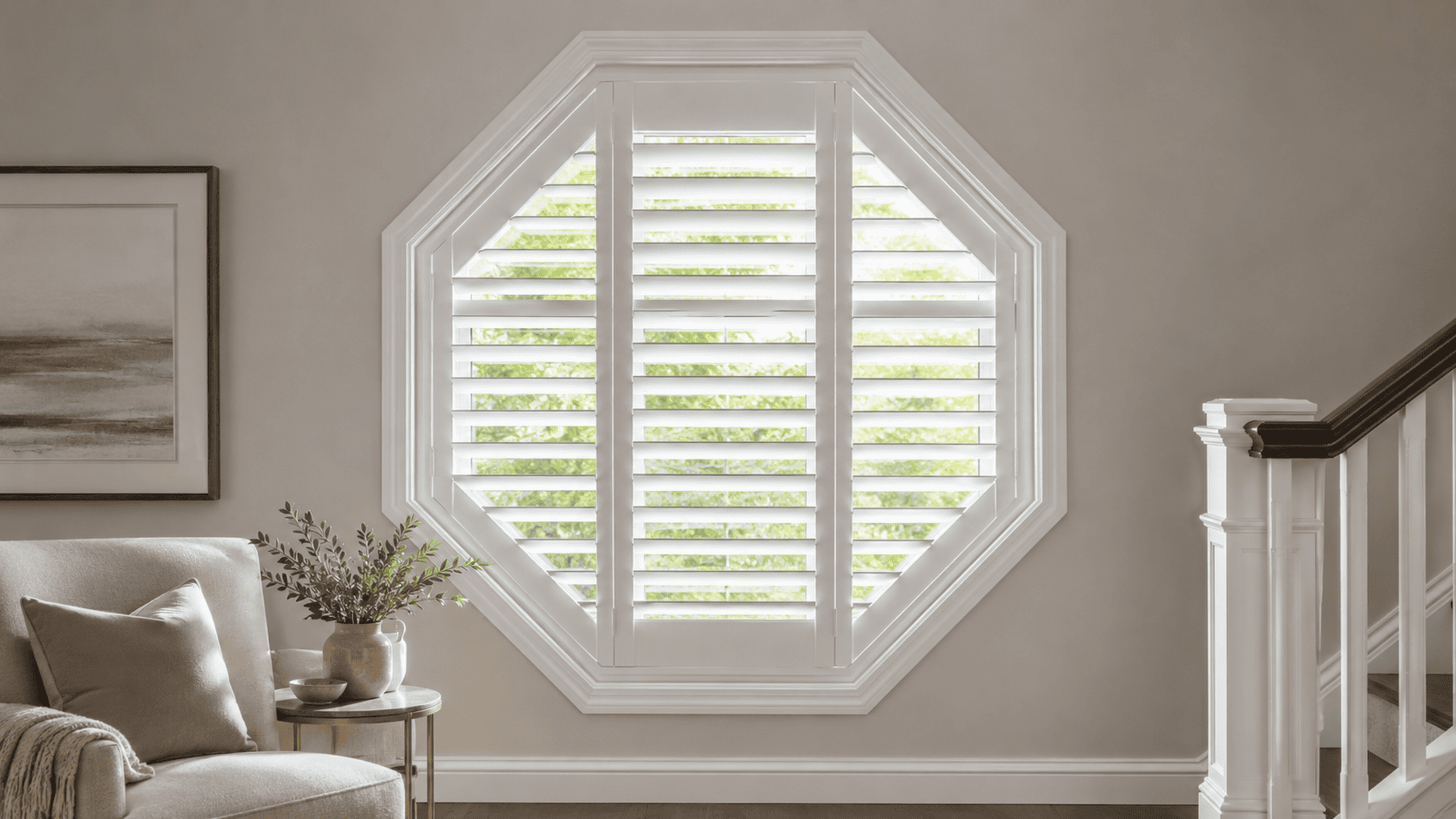
Octagon Window Shutters: Custom Options, Fit and Design Considerations
Author: Nigel Harris
September 1, 2026.
Octagon windows bring distinctive geometry and architectural character to a room. However, their eight-sided shape also makes them more challenging to cover without losing the feature that makes them special.
Custom octagon window shutters can follow the angles of the opening, provide adjustable light control, add privacy, and create a more finished interior appearance. Instead of placing a rectangular covering over the window, a made-to-measure shutter can work with its original proportions.
The best result depends on more than the overall width and height. Frame depth, individual angles, surrounding trim, louver proportions, accessibility, and mounting space all influence how the finished shutters will look and operate.
Why Octagon Window Shutters Require a Custom Fit
An octagonal window cannot be treated like a standard square or rectangular opening. Even when the window appears symmetrical, small differences between its sides and angles can affect the fit.
Custom shutters are measured and designed around the actual opening. This allows the frame and panel to follow the octagonal outline rather than covering it with a conventional rectangular shape. You can choose octagon designs as part of custom specialty-shaped windows solutions.
A tailored design can help you:
Keep all eight sides of the window visible;
Manage direct sunlight and glare;
Add privacy without permanently concealing the glass;
Coordinate the window with nearby shutters or interior trim;
Give an unusual opening a more intentional, built-in appearance.
The objective is not simply to fill the opening. It is to create shutters that feel visually connected to the architecture around them.
How Custom Shutters Preserve an Octagonal Window’s Shape
Octagon window shutters need to follow eight angled sides, so the design depends on more than standard width and height. A professional measurement helps confirm whether each side is even, how the angles meet, and how much depth is available for the frame and louvers.
These details matter because small variations can change how closely the shutter follows the window’s outline. Accurate measurements help avoid uneven borders, oversized framing, or a panel that makes the octagon look less intentional.
Mounting is also important. An inside mount often works well for octagonal windows because it keeps the shutter within the original opening and helps preserve the eight-sided shape. If the recess is too shallow or the trim creates clearance issues, your design consultant may recommend another mounting approach that still keeps the octagonal outline as visible as possible.
The final layout should also account for how the window is placed in the room. A small decorative octagon window may not need frequent access, while a larger octagon window at eye level may need easier panel operation and more flexible light control. Your consultant can evaluate those details so the shutters look balanced and work the way you expect.
Read also:
White Window Shutters: Why They Still Look Modern and Premium
Are Black Shutters a Good Idea? When They Work (and When They Don’t)
Light Control and Privacy With Octagonal Window Shutters
Octagon windows are frequently used as architectural accents, but they can still admit strong sunlight or create an exposed view into the room. These issues may be especially noticeable when the window faces a street, neighboring property, or bright afternoon sun.
Adjustable louvers allow you to change how light enters without completely hiding the glass. You can tilt them to soften glare, reduce a direct line of sight, or bring more daylight into the room. Louvers are the individual slats that rotate to manage light entry and privacy.
Your preferred louver position may depend on the room:
Bathrooms: Privacy may be the main priority, particularly when the window is near a tub or vanity.
Bedrooms You may want to reduce early morning brightness while maintaining the window’s architectural detail.
Stairways and landings: Glare control may be more important than full privacy.
Living spaces: Adjustable light can help protect visual comfort without making the room feel closed in.
Entry areas: Shutters can limit outside visibility while preserving a polished focal point.
Shutters are designed to manage light rather than guarantee complete darkness. Small paths of light may remain around the louvers or panel edges, particularly in a complex geometric opening. Discussing your expectations during the consultation helps determine whether the proposed design is suitable for the room.
Design Choices for Interior Octagon Window Shutters
The shutter should relate to both the window and the surrounding interior. Proportion, finish, frame style, and nearby architectural details all contribute to the final effect.
Louver Size and Window Proportion
Louver size affects both appearance and visibility through the window. On a small octagon window, oversized components may make the design feel crowded. On a larger opening, very narrow louvers may create a busier appearance than intended.
The right proportion should leave enough visual space for the octagonal frame to remain clear while still providing useful light adjustment. Your consultant can show how different options will look relative to the size of the opening.
Color and Finish
A finish that coordinates with the window trim can create a seamless, built-in effect. A contrasting finish may emphasize the octagon as a deliberate design feature.
Consider how the shutters will relate to:
Baseboards and crown molding;
Door and window casing;
Wall color;
Flooring and wood tones;
Nearby cabinetry;
Other custom interior shutters in the room.
A bright, trim-coordinated finish can make a small window feel clean and crisp. A stained or warmer finish may add visual depth when it complements existing wood details.
Visual Alignment With Nearby Windows
An octagon window may appear beside rectangular windows, above a doorway, or as a stand-alone architectural detail. The shutter design does not need to match every nearby window component exactly, but it should feel related.
Consistent finishes, similar louver proportions, and compatible frame details can connect the octagonal window with the rest of the room. The goal is cohesion without forcing a standard configuration onto a nonstandard shape.
Inside Mount vs. Outside Mount for Octagon Windows
Choosing between an inside and outside mount is one of the most important design considerations for shutters for an octagon window.
An inside mount places the shutter within the window recess. This approach generally preserves the visible geometry of a specialty-shaped window and keeps the treatment visually compact.
An outside mount positions the frame on the surrounding trim or wall. It can be useful when the opening lacks sufficient depth or contains obstructions, but it may cover part of the octagonal outline or make the opening appear more rectangular.
Shutters.com’s mounting guidance notes that inside mounts help retain the distinct shape of uniquely shaped windows, while outside mounts may be needed for shallow frames or interfering hardware.
Before selecting the mount, check:
Whether the recess has enough usable depth;
Whether trim reduces the available opening;
Whether cranks, sensors, handles, or locks create obstructions;
Whether the window is noticeably uneven;
How much of the octagonal outline should remain exposed;
Whether the surrounding wall provides enough space for an outside frame.
The best mount is the one that balances shape preservation, clearance, light control, and a clean finished appearance.
Read more:
How to Clean Shutters (and What to Avoid)
Repair or Replace? The Signs Your Shutters Need Attention
What to Check Before Ordering Shutters for an Octagon Window
A few practical questions can help you prepare for the design consultation and clarify what you need from the finished shutters.
How Do You Use the Room?
Think about whether your priority is privacy, glare reduction, decorative impact, or a combination of these. A bathroom octagon window may require a different balance from a decorative window above a staircase.
Is the Window Easy to Reach?
A window placed high on a wall may not need frequent panel operation, but you may still want the louvers positioned for appropriate light and privacy. Accessibility should be considered before the final configuration is selected.
Does the Opening Have Enough Depth?
Depth influences the mounting method and the amount of clearance available for the shutter components. Decorative trim, deep casing, shallow recesses, and existing hardware should all be assessed.
Is the Window Truly Symmetrical?
Do not assume that every side and angle is identical. Installation, settling, trim, and construction tolerances can create small differences. A custom survey captures the actual shape rather than relying on nominal window dimensions.
Should the Finish Match Nearby Trim?
Matching the trim can help the shutter blend into the architecture. A coordinated contrast can work when you want the window to act as a stronger focal point. Review physical finish samples in the room whenever possible, since natural and artificial light can change how a color appears.
What Level of Light Control Do You Expect?
Determine whether you mainly want to soften brightness, redirect sunlight, improve privacy, or make the room substantially darker. Clear expectations make it easier to select an appropriate design.
What to Expect During a Custom Shutter Consultation
During an in-home consultation, your design consultant can inspect the complete opening rather than relying on a single width-and-height measurement.
The consultation may include:
Reviewing how you use the room;
Measuring the window’s sides, angles, depth, and surrounding trim;
Identifying hardware or clearance limitations;
Discussing mounting possibilities;
Comparing frame, louver, color, and finish options;
Reviewing how the shutters are expected to operate;
Coordinating the order and installation details.
Custom measuring is especially valuable for specialty-shaped windows because the final design must respond to the actual geometry. Shutters.com offers custom interior shutters for specialty shapes and uses in-home design consultations to help determine fit and configuration.
Installation services are available, and your design consultant will help you schedule installation during your consultation when placing your order.
Give Your Octagon Window a More Finished Look
A distinctive window should remain a visible part of the room rather than becoming hidden behind a standard rectangular covering. Properly planned interior octagon window shutters can follow the original shape, improve privacy, manage changing daylight, and make the opening feel more connected to the surrounding architecture.
The most important decisions involve accurate measurements, mounting depth, louver proportion, frame design, finish, and expected operation. Because every eight-sided opening can vary slightly, an in-home assessment provides the information needed to design around the real window.
Schedule a free in-home design consultation to explore custom octagon window shutters and find a solution shaped around your space.