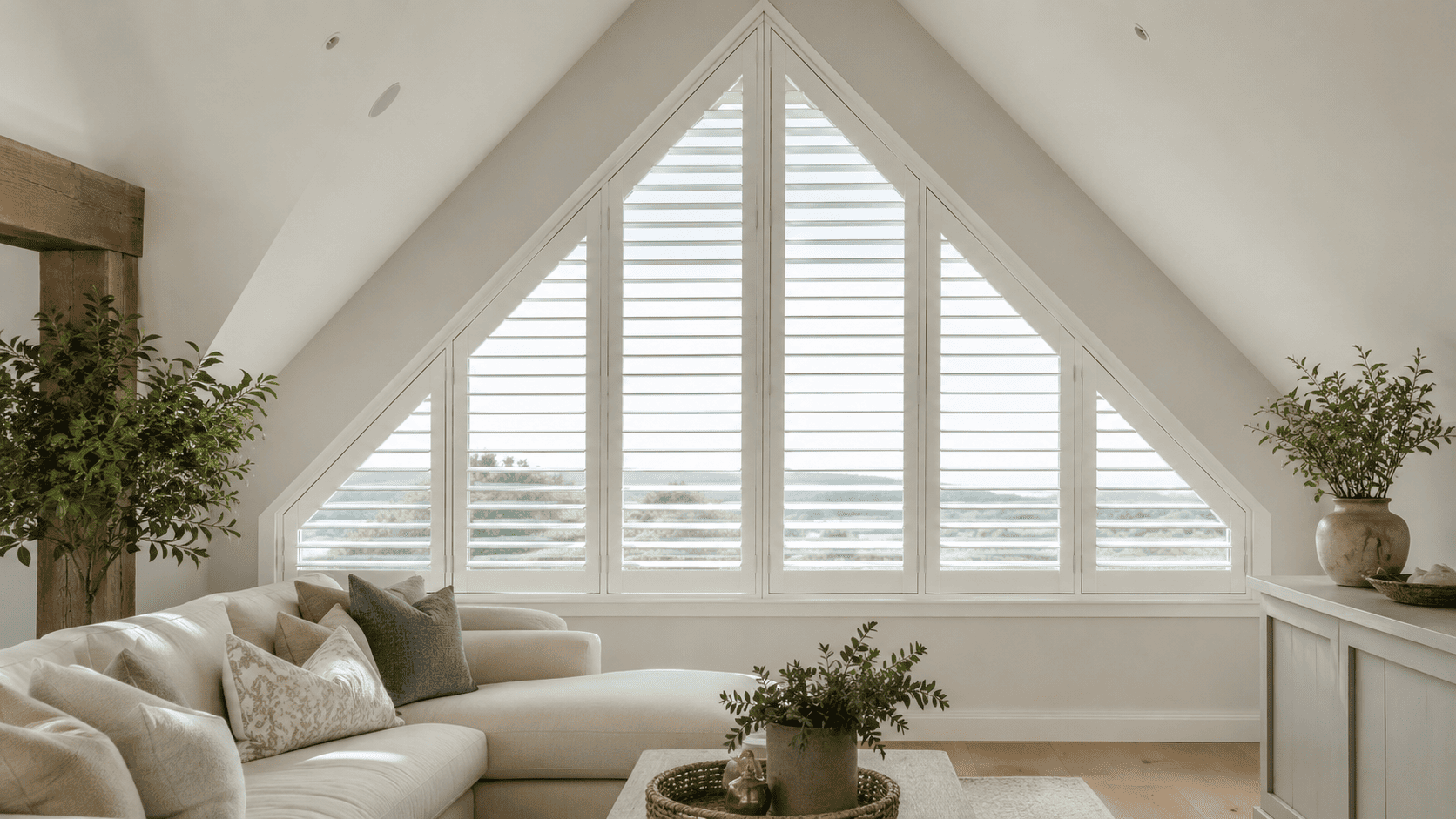
Triangular Window Shutters: What Homeowners Need to Know
Author: Nigel Harris
September 1, 2026.
Triangular windows can add height, daylight, and architectural interest to a room, especially in spaces with vaulted ceilings, gables, or angled rooflines. They can also be difficult to cover without hiding the shape that makes them unique.
Triangular window shutters can be a tailored solution because they are designed around the angles of the opening rather than placed over it as a standard rectangle. Still, the shape affects what is possible. The angle, peak width, depth, location, and surrounding trim all influence the final design.
Here is what you should know before choosing shutters for triangular windows.
Are Triangular Window Shutters a Practical Solution?
Triangular window shutters can work well when the design is based on the exact opening and how you need the window to function.
A custom shutter can follow the triangular outline, helping the window remain an architectural feature while adding coverage. This is especially useful when the triangle sits under a roof peak, above a larger window, or within a feature wall.
Shutters can also help you manage glare, daylight, and privacy. However, the amount of control may vary across the window. The wider lower section often allows more louver movement, while the narrow peak may require fixed louvers or limited operation.
A design consultant will typically evaluate:
The size and angle of each side
The width at the narrowest point
The available mounting depth
The condition of the trim or wall surface
Locks, cranks, screens, or other obstructions
Whether the panel needs to open, remain fixed, or be removable
These details determine whether the shutter can be fully operable, partially operable, or primarily decorative.
How Shape Affects Triangular Window Shutter Design
The changing width of a triangular window affects the frame, louvers, and panel operation. The closer the design gets to the peak, the less room there may be for movable parts.
Louver Movement May Be Limited Near the Peak
In a triangular shutter, louvers become shorter as they move toward the top of the window. At the narrowest point, there may not be enough room for full louver movement.
That does not mean shutters are not practical. It simply means the upper section may need a different configuration, such as fixed louvers or a smaller operable area.
Operation Depends on the Design
Some triangular window shutters are designed as fixed framed units with adjustable louvers. Others may include a hinged or removable panel if the window size, weight, and surrounding clearance allow it.
For louvered specialty shapes, Clear View Tilt may be available to create a cleaner look without a visible front tilt bar. Tilt Magic, a motorized tilt option, may also be available for louvered specialty shapes, but only the straight-leg portion of a specialty shape can be motorized. Any shaped or curved sections on other specialty windows must be adjusted manually.
For triangular windows, this means motorization may be possible in some straight sections, but the final option depends on the exact shutter design. Your consultant should explain which sections can adjust, which may remain fixed, and whether manual or motorized operation is available.
The Frame Should Look Integrated
The frame is especially important on angled windows because it defines the finished outline. A heavy frame can overpower a smaller triangle, while a frame that is too minimal may not provide enough support.
The best result usually comes from a frame profile that follows the shape cleanly and coordinates with nearby trim, windows, or existing shutters.
Read also:
Shutters for Every Window Type & Shape: Bay, Arched, Doors & More
Window Shutter Ideas by Home Style: Modern, Farmhouse & Coastal
Measuring Triangular Window Shutters
Accurate measuring is essential because triangular windows cannot be measured like standard rectangles.
A consultant may need to account for the base width, vertical or diagonal height, side lengths, corner angles, recess depth, and any irregularities in the opening. Even if the window looks symmetrical, one side may differ slightly from the other.
The surrounding area also matters. Trim, sill depth, ceiling angle, wall surface, hardware, and nearby architectural details can all affect whether the shutter should sit inside the opening or mount around it.
If the triangular window sits above rectangular windows, the full window group should be planned together so frame lines, louver size, finish, and panel divisions feel connected.
Inside or Outside Mount for Triangular Window Shutters?
Choosing an inside or outside mount affects both the fit and the appearance of the finished window. With triangular openings, preserving the architectural outline is often a central part of the decision.
When an Inside Mount May Work Best
An inside mount positions the shutter frame within the window recess. This can create a streamlined appearance and keep the original trim visible.
It may be suitable when:
The recess has enough usable depth
The opening is structurally consistent
There are no major hardware obstructions
The angles can accommodate the required frame
You want to emphasize the precise triangular shape
Because the frame follows the interior of the opening, small irregularities must be measured carefully.
When an Outside Mount May Be More Practical
An outside mount positions the shutter frame on the wall or trim surrounding the window.
This configuration may be considered when the recess is too shallow, uneven, or obstructed. It can provide more mounting flexibility, but the frame’s placement must be planned carefully so it does not make the triangle feel heavier or conceal too much of its shape.
The right approach depends on more than visual preference. Your consultant should evaluate depth, structure, clearance, and the amount of coverage required before recommending a mount.
Privacy and Light Control With Shutters for Triangular Windows
Privacy and Light Control With Shutters for Triangular Windows
Your privacy and light-control needs depend on where the triangular window is located.
Lower triangular windows may need more privacy, especially if they face a street, sidewalk, or neighboring property. The design should be evaluated from both inside and outside so you understand how much coverage the louvers and any fixed sections will provide.
High triangular windows often create less privacy concern but may introduce glare. Adjustable louvers can help soften sunlight while keeping the room bright, which can be useful in living rooms, dining areas, stairwells, and rooms with screens or reflective surfaces.
Window orientation also matters. A window with strong afternoon sun may need more control than one that receives mostly indirect light.
Design Choices That Keep the Look Balanced
Triangular window shutters should feel like part of the architecture, not an added cover.
Choose a louver size that suits the window. Larger louvers can create a cleaner look, but the narrowing shape may limit how far they can extend toward the peak. Smaller louvers may offer more flexibility in some cases, though too many narrow lines can make the window feel busy.
The finish should also coordinate with nearby trim, walls, flooring, and other shutters. White or neutral shutters often create a subtle, finished look, while a stained finish may work when you want the window to stand out as a design feature.
When possible, keep the configuration simple. A triangular window already has a strong shape, so too many divisions can distract from it.
Read more:
Choosing Shutter Colors & Finishes: White, Stained Wood & Painted Options
Top 10 Tips to Care for your Indoor Shutters
Questions to Ask During Your Shutter Consultation
Before ordering triangular window shutters, ask clear questions about fit, movement, and daily use.
Useful questions include:
Can shutters be made for the exact angles of this window?
Which sections of the louvers will be adjustable?
Will any part of the upper point need to remain fixed?
Can the panel swing open, or will it stay within the frame?
Which mounting style is most appropriate for the available depth?
Will the frame cover any of the glass or existing trim?
How will the design align with the windows below or beside it?
Can the shutters be reached easily for adjustment and cleaning?
Which louver size will look most balanced in the narrowing opening?
Are there structural or clearance limitations that affect feasibility?
How will installation details be coordinated when the order is placed?
Your design consultant can help you understand what is possible before the design is finalized.
Frequently Asked Questions About Triangular Window Shutters
Because angled windows do not follow standard proportions, questions about fit and operation are common. The answers depend on the exact window, but these general principles can help you prepare.
Can Shutters Fit Any Triangular Window?
Not necessarily. Many triangular windows can accommodate custom shutters, but feasibility depends on dimensions, angles, frame depth, mounting surfaces, and product limitations.
A detailed in-home assessment is the best way to determine which configuration is possible.
Do Triangular Shutter Panels Open?
Some can, but not all. Depending on the design and available clearance, the panel may open, be removable, or remain fixed within the frame.
Can All the Louvers Move?
The louvers in the wider lower area may have more room to operate than those near the narrow upper point.
Depending on the design, the smallest upper louvers may have limited movement or may need to remain fixed. Your consultant should explain which sections will be adjustable before the order is finalized.
Are Triangular Window Shutters Good for Privacy?
They can improve privacy when the design provides appropriate coverage and louver adjustment. The result depends on the height of the window, viewing angles, panel configuration, and whether any sections remain fixed or partially open.
Privacy should be evaluated from both inside and outside the room.
Can Shutters Be Used on High Triangular Windows?
High triangular windows may be suitable for shutters, but accessibility becomes an important consideration.
You should discuss how the shutters will be adjusted, how often you expect to operate them, and how the panels and louvers can be cleaned safely. In some high locations, a simpler configuration may be more practical than one requiring frequent manual access.
Plan the Right Solution for Your Triangular Window
Triangular window shutters can provide a finished look while helping with light control and privacyThe key is choosing a design that fits the exact angles of the window and works with how you use the room.
Before deciding, consider whether the window needs daily adjustment, whether it is easy to reach, how much glare or privacy control you need, and how the shutter will coordinate with nearby windows.
During an in-home consultation, your design consultant can measure the opening, review mounting options, explain which sections can operate, and help determine whether triangular window shutters are a practical fit for your space.