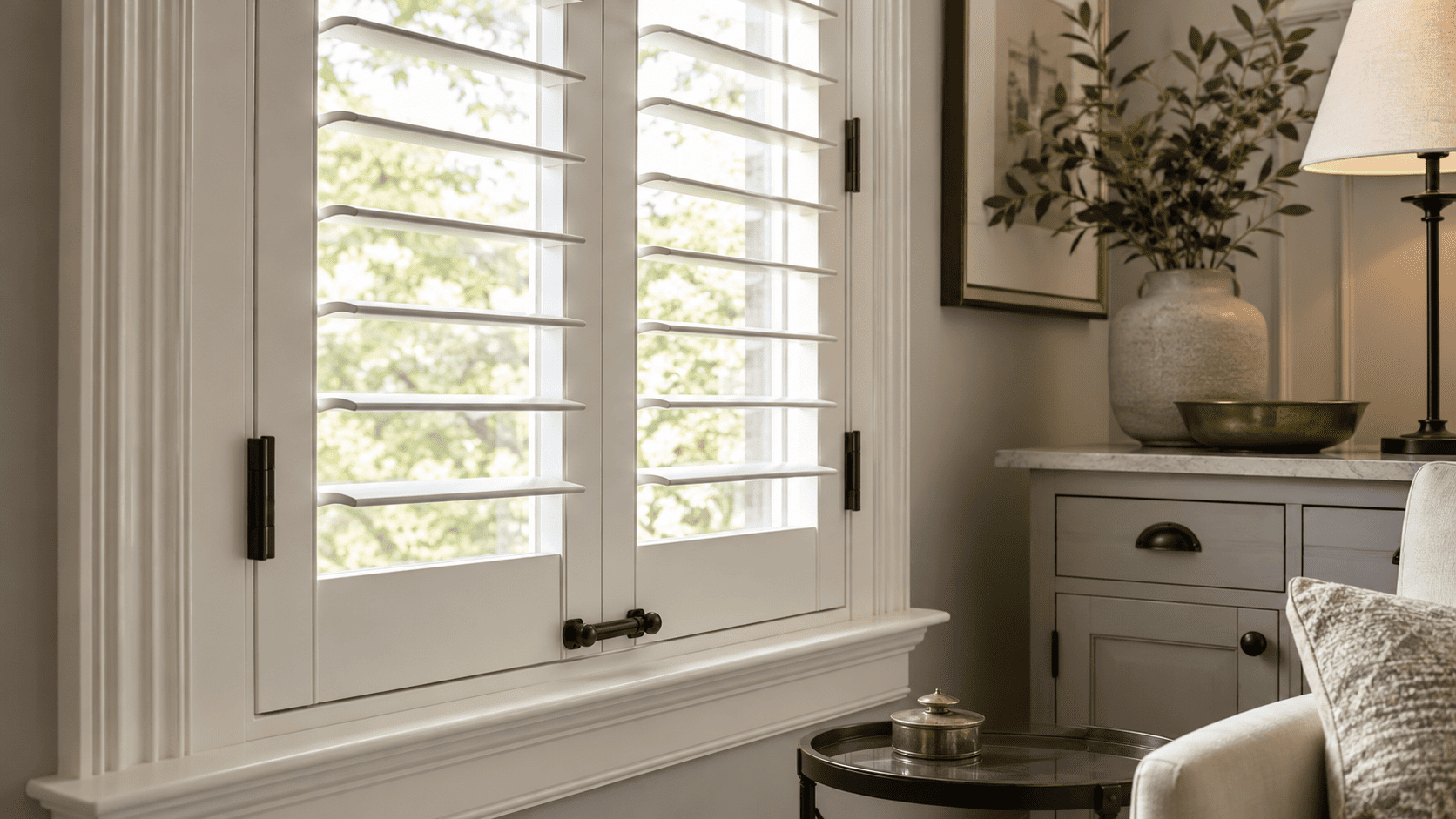
Interior Shutter Hardware: How Finish Choices Affect the Final Look
Author: Nigel Harris
September 2, 2026.
When you picture new shutters, you may focus first on color, louver size, or panel configuration. However, interior shutter hardware also contributes to how the finished window looks. Hinges and other visible operating details may be relatively small, but their finish can either blend quietly into the design or create a noticeable decorative accent.
The right choice depends on more than selecting a metal color you like. Shutter color, window trim, nearby fixtures, room style, panel size, and the amount of contrast you want all influence whether the hardware feels coordinated.
Understanding these relationships can help you choose interior window shutter hardware that supports the overall design instead of looking like an afterthought.
What Is Included in Interior Shutter Hardware?
The term interior shutter hardware can refer to several functional components. Some are clearly visible, while others remain discreet once the shutters are installed.
Depending on the shutter configuration, visible or partially visible components may include:
Hinges connecting the shutter panels to the frame
Hinges joining folding panels
Fasteners associated with visible hardware
Panel catches or closure components
Operating details used to adjust the louvers
The tilt rod is also an important visual and operating feature, although it is typically coordinated with the shutter rather than treated as a separate metal finish. If you are unfamiliar with this component, learning what a louver is and how the louvers operate can make the available configurations easier to compare.
Not every hardware component will be offered in every finish or remain equally visible. Panel layout, frame selection, mounting method, and the position from which you normally view the window all affect what you will notice.
How Hardware Finish Changes the Look of Interior Shutters
Hardware finish influences whether the shutters appear seamless, detailed, traditional, or contemporary. The effect is often subtle on one window but becomes more pronounced when the same choice is repeated throughout a room.
Coordinated Hardware Creates a Quieter Result
Hardware that closely relates to the shutter color tends to recede visually. This approach keeps attention on the panels, louvers, and overall proportions of the installation.
A lower-contrast result may suit you when:
You want a clean and restrained window design
The shutters are already a strong architectural feature
The room uses a limited color palette
You want several windows to feel consistent without adding more visual detail
On light-colored shutters, a light or softly toned finish can help the hinges feel integrated. On darker or stained shutters, deeper finishes may create a similarly cohesive effect.
Contrasting Hardware Adds Definition
A contrasting finish makes the functional details more visible. Dark hardware against light shutters, for example, can outline the hinges and bring more attention to how the panels are constructed.
This can work well when the contrast feels intentional and is repeated elsewhere in the room. It may coordinate with cabinet pulls, door hardware, lighting, or other architectural details.
Contrast should still be used with restraint. The hardware needs to support the shutters rather than become the first feature you notice at the window.
Read also:
Choosing Shutter Colors & Finishes: White, Stained Wood & Painted Options
How Shutters Improve Privacy and Light Control in Your Home
Choosing Interior Window Shutter Hardware for Your Style
There is no single finish that works with every interior. The best choice supports the broader design language of the room, including its shapes, materials, colors, and level of detail.
Clean and Contemporary Interiors
Contemporary rooms often benefit from hardware that blends into the shutter or creates a controlled, deliberate contrast. Clean lines and limited ornamentation usually matter more than decorative hardware.
For this look, consider how the hardware works with:
Simple window trim
Neutral or monochromatic colors
Larger louvers
Streamlined frames
Matte or softly reflective metal finishes elsewhere in the room
A contrasting finish can still work in a modern space, particularly when black or dark metal details are already used consistently. The key is repetition. A single contrasting element without any connection to the rest of the room may appear accidental.
Traditional and Detailed Rooms
Traditional interiors can accommodate more visible hardware because the room may already include detailed trim, paneled doors, decorative molding, or classic furniture.
A warmer or deeper hardware finish can complement these features, especially when paired with stained shutters or warm white finishes. The goal does not have to be an exact match. Related undertones may create a more natural result than trying to duplicate every metal surface precisely.
Transitional Interiors
Transitional spaces balance classic structure with simpler contemporary details. Because the style sits between two visual directions, shutter hardware should usually feel refined without becoming overly decorative.
You might select hardware that:
Echoes the room’s dominant metal finish
Creates gentle contrast rather than a sharp outline
Connects traditional window trim with cleaner furniture
Works with both current and future décor updates
This flexibility can be useful if you expect to change furnishings, wall colors, or lighting while keeping the shutters in place.
Should Shutter Hardware Match Other Metal Finishes?
Interior shutter hardware does not need to match every handle, hinge, faucet, or light fixture in your home. A room can include more than one metal finish and still feel cohesive.
Coordination is usually more important than exact matching.
Start With the Closest Architectural Details
First consider the permanent or semi-permanent features nearest to the window:
Door hinges and handles
Cabinet hardware
Window locks
Lighting fixtures
Fireplace details
Built-in shelving hardware
These features have a stronger visual relationship with the shutters than small decorative objects elsewhere in the room.
Look for Compatible Undertones
Metal finishes often have warm, cool, or neutral undertones. Two finishes do not have to be identical if they share a similar visual temperature.
For example, a warm metal finish may coordinate naturally with cream paint, warm wood, and beige or brown textiles. Cooler finishes may feel more connected to gray paint, crisp white trim, black accents, or cooler flooring.
Repeat a Contrasting Finish Intentionally
When shutter hardware contrasts with the panel color, repeating that finish elsewhere can make the decision feel purposeful. Even two or three related details may be enough to create a connection.
The repetition does not have to appear directly beside the window. It simply needs to be visible within the same space.
How Shutter Color Affects the Hardware Finish
The same hardware finish can look very different depending on the shutter color behind it. Always evaluate the two elements together rather than choosing them independently.
White and Off-White Shutters
Light shutters create the clearest distinction between blended and contrasting hardware.
Light hardware tends to keep the window looking simple and continuous. Dark hardware creates greater definition and may introduce a farmhouse, traditional, or graphic quality, depending on the other room details.
Warm off-white or cream shutters may pair more naturally with warm or muted finishes than with highly cool, reflective metal.
Gray Shutters
Gray can contain blue, green, brown, or neutral undertones. Because of this variation, you should compare the hardware directly with the specific shutter sample.
Dark finishes can create a subtle or pronounced contrast depending on the depth of the gray. Softer metallic finishes may add definition without producing a sharp outline.
Black or Deep-Colored Shutters
Dark shutters often reduce the visibility of equally dark hardware, creating a unified appearance. Lighter or more reflective finishes will be more noticeable and can introduce a decorative effect.
Because deep shutter colors already have a strong presence, additional contrast should connect clearly with the room rather than competing with the window.
Stained Shutters
Stained shutters introduce natural variation in color and grain. Hardware can either relate to the darker tones within the wood or provide controlled contrast.
Warm, aged, or deeper finishes often complement traditional wood tones, while simpler dark finishes can make stained shutters feel more streamlined. The surrounding furniture and flooring will also influence the result.
Consider the Frame, Mount, and Louver Size Together
Shutter hardware is only one part of the finished design. Frame profile, mounting method, panel arrangement, and louver size determine how much visual detail already surrounds the window.
Frame Style Influences the Level of Detail
A more decorative frame can support visible hardware because both elements contribute to a detailed architectural look. A simpler frame may work better with restrained hardware, particularly when you want a low-profile result.
The frame also affects the spacing between the shutters and the surrounding trim. This changes how clearly the hinges can be seen from different positions in the room.
Mounting Method Changes the Overall Composition
An inside or outside mount affects how the shutter frame relates to the existing window casing. An inside mount can preserve more of the original trim, while an outside mount may introduce a stronger frame around the opening.
Because these mounting methods create different visual boundaries, the same hardware finish may feel subtle in one configuration and more noticeable in another.
Louver and Panel Scale Affect Visual Balance
Larger louvers and broad panels create fewer, stronger lines across the window. Small, highly contrasting hardware may stand out more against this simplified design.
Smaller louvers or multi-panel configurations already contain more repeated lines and joints. In these cases, restrained hardware may help prevent the window from appearing overly detailed.
Common Hardware Finish Mistakes to Avoid
A thoughtful hardware choice considers the complete room rather than an isolated sample. Several common decisions can make the final installation feel less coordinated.
Matching only one temporary accessory: A lamp or decorative object may be replaced, while the shutters will remain. Prioritize permanent room details.
Ignoring the shutter undertone: A metal finish may work with the wall color but conflict with the shutter’s warm or cool undertone.
Adding contrast without repetition: Contrasting hardware usually looks more intentional when a related finish appears elsewhere.
Choosing from a photo alone: Lighting and screen settings can change how both the shutter and hardware finish appear.
Treating every room identically: Consistency matters, but different rooms may require different levels of contrast or coordination.
Reviewing hardware separately from the frame: Panel layout, frame profile, and mount style can change how prominent the hardware becomes.
Read more:
Internal Shutters: The Complete Buyer’s Guide (2026)
Shutters for Every Window Type & Shape: Bay, Arched, Doors & More
Can Hardware Finishes Vary Between Rooms?
Using one finish throughout the home can create continuity, especially when rooms connect visually or shutters are visible from a shared hallway. However, every window does not automatically require the same hardware treatment.
A different choice may make sense when:
One room has a distinct shutter color
The surrounding architectural hardware changes
A private room has a different interior style
Stained shutters are used in one area and painted shutters in another
The level of desired contrast varies by space
For open-plan areas, maintaining the same shutter and hardware combination generally creates a more unified result. In separated rooms, you may have more flexibility.
The most important consideration is whether each decision looks deliberate within its surroundings.
Review Hardware in the Room Before Making a Decision
Small samples are helpful, but they should be reviewed in the actual room whenever possible. Natural light, artificial lighting, wall color, flooring, and nearby finishes can all change how the hardware appears.
During a free in-home design consultation you can compare shutter colors, frame options, configurations, and available finish details against the permanent features already in your space.
Before making a final selection, review the hardware from several positions:
Close to the window
From the main entrance to the room
From the primary seating area
In daylight and artificial light
With the shutter panels opened and closed
This helps you understand whether the hardware blends into the installation or adds the amount of definition you intended.
Bring Every Shutter Detail Into One Cohesive Design
The most successful interior shutter hardware choice is not necessarily the most decorative or the least visible. It is the finish that makes sense with the shutter color, window trim, frame, panel layout, and surrounding room details.
When each element is considered together, the shutters feel integrated into the architecture rather than added to it. Your hardware can remain subtle, create purposeful contrast, or reinforce a particular interior style without overwhelming the window.
Because custom interior shutters are designed for the individual opening, you can evaluate these details as part of one complete window design. Your design consultant can help you compare the available options, measure the window, and determine which combination will create the most balanced final result. Installation services are also available, and your consultant can coordinate installation details as part of the overall project experience.